
It’s the first decision every faceless creator hits: generate the voice, or record your own? The internet argues about this in absolutes — “AI voice is dead,” “nobody cares about voice anymore” — and both camps are selling something. The truth is less dramatic and more useful: YouTube does not rank voices. It ranks watch time. Your voice, human or synthetic, is simply one of the tools that earns or loses watch time.
The honest note first: neither choice guarantees anything. Channels with flat AI narration have died at 200 views, and channels with charming real voices have died at the same number, because the script, topic, and first 30 seconds mattered more than the vocal cords involved. What this article gives you is an accurate picture of what each option actually does to retention, trust, and your production speed — so you choose based on your niche and your constraints, not on a guru’s blanket rule.
This is a production decision inside the YouTube engine of the Side Hustle in 2026 Using AI roadmap — and like every production decision there, it’s subordinate to topic and script.
What YouTube Actually Measures
Strip the mystery away: the algorithm promotes videos that keep people watching and keep people on the platform. For a faceless video, the voice influences exactly three measurable things:
- First-30-seconds retention — does the narration sound confident and natural enough that a stranger doesn’t click away?
- Average view duration — does the delivery stay listenable for 8–12 minutes, or does it become fatiguing?
- Return viewers — does the voice become part of the channel’s identity that people come back for?
Everything else — comments saying “nice voice,” your own preference — is decoration. Judge both options against those three numbers only.
The Case for Your Real Voice
Trust and identity. A real human voice carries micro-imperfections — emphasis, pauses, genuine reactions — that listeners subconsciously read as “a person made this.” In trust-heavy niches (finance, business, advice, storytelling), that signal compounds: viewers subscribe to a voice they recognize, and recognition is the one moat a small channel can build early.
Policy safety. YouTube’s reused content policy rejects channels that feel mass-produced with no original value. Your own narration over your own script is the clearest possible evidence of authorship. Nobody has ever been rejected from the Partner Program for sounding too human.
It costs nothing and never expires. No subscriptions, no character limits, no terms-of-service surprises. And it improves with reps — most creators are noticeably better by video twenty, having spent zero dollars.
The costs are real, though: recording takes time, retakes multiply, a noisy room or a bad microphone hurts you, and if anonymity is the entire point of your channel, your voice may feel like exposure — accents identify people, and some creators have employers or communities they’d rather keep separate.
The Case for AI Voice
Speed and consistency. A 1,400-word script becomes finished narration in minutes, at the same energy level at 1 a.m. as at noon, in episode 4 as in episode 40. For a batch-production system — the kind this series teaches for your first 100 videos — that consistency is a genuine strategic advantage. The bottleneck moves back to scripting, where it belongs.
Anonymity and flexibility. No voice recognition, no recording environment, no performance anxiety. You can also change languages: the same script can become channels in markets you’d never record in yourself.
The quality gap has narrowed — at the top end. Premium text-to-speech in 2026 handles emphasis, pacing, and emotion well enough that most viewers in most niches cannot tell, and many who can tell don’t care. The catch is in that sentence: premium. The free, flat, robotic tier of TTS absolutely does still bleed retention — listeners describe it as “tiring” without knowing why, and your average view duration shows it.
What Actually Differs in the Numbers
No public dataset settles this, so be skeptical of anyone quoting you an exact percentage. But the consistent pattern across creator reports and channel case studies is this:
- Script quality swamps voice quality. A gripping script in decent AI voice routinely out-retains a dull script in a beautiful real voice. Retention graphs punish boring, not synthetic.
- Where AI voice underperforms, it’s the first 30 seconds. A robotic opening costs you the click-stayers before the content can save it. Human voices get a few seconds more grace.
- Niche changes the answer. News-style, list, and explainer content tolerates AI narration easily — the information is the product. Personal-story, opinion, and advice content leans on vocal trust, and AI narration fights the format.
- Comment complaints are a lagging indicator. Viewers rarely leave over voice alone; they leave over voice plus generic script plus stock visuals — the full “content farm” pattern. Any single synthetic element is fine. All of them together reads as mass-produced, to viewers and to policy reviewers alike.
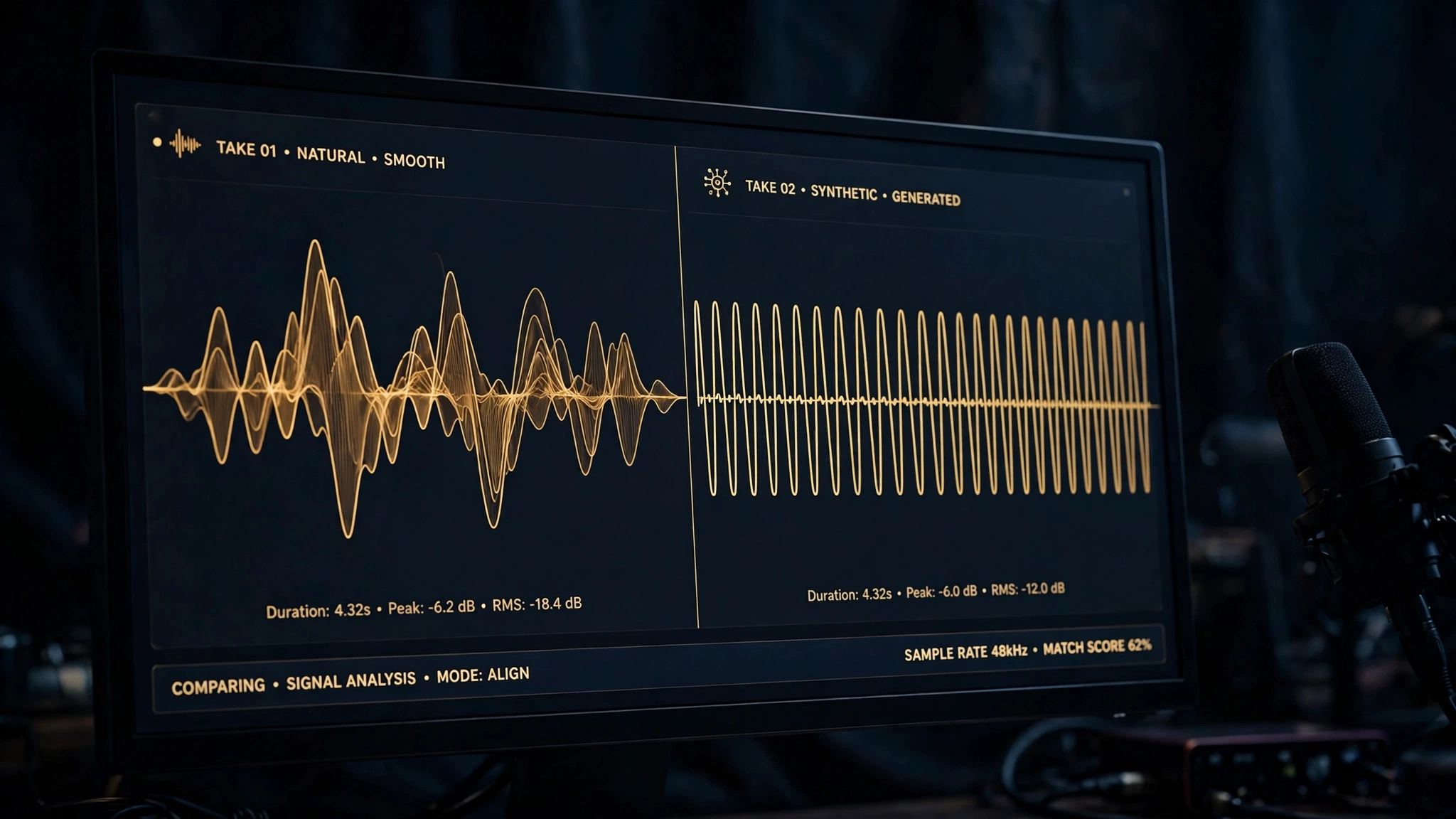
The Hybrid Setup Most Winners Use
The channels that scale tend to converge on one of three hybrids:
- Human voice, AI everything else. AI scripts (heavily rewritten), AI visuals, human narration recorded in batches on a phone. Maximum trust per dollar, moderate time cost.
- Premium AI voice, human everything else. Your scripts, your structure, your editing judgment, synthetic narration — with manual fixes to pronunciation, pauses, and emphasis line by line. Fastest production, small subscription cost, retention depends on your direction of the voice, not the voice itself.
- AI voice for Shorts, human for long-form. Shorts reward speed and volume; long-form rewards trust. Many creators run both formats on one channel and split the voice strategy exactly this way.
Whichever you choose, run the only test that counts: publish comparable videos both ways in your first twenty uploads, then compare first-30-seconds retention and average view duration in YouTube Analytics. Your niche’s audience will tell you the answer in data. No article — including this one — outranks your own analytics.
The Cost Math Nobody Mentions
Run the numbers honestly, because “free vs paid” is only half the ledger. Your real voice costs $0 in subscriptions but roughly 30–60 extra minutes per video at the start — recording, retakes, and cleanup — shrinking to perhaps 15 minutes once you’re practiced and batching. Premium AI voice costs a monthly subscription (typically the price of a couple of coffees at the tiers creators actually use) and reduces narration to a few minutes of generation plus spot-fixes.
Now multiply by your production system: at four videos a month, a real voice might cost you two to three hours; at twenty pieces of content a month across long-form and Shorts, it can cost ten — time that comes directly out of scripting, which is the input that actually determines retention. Neither answer is wrong. The discipline is to choose based on your bottleneck: if you have evenings but no budget, your voice is the asset. If you have a small budget and scarce hours, buying back narration time is one of the few subscriptions that pays for itself — but only after your scripts are proven, because a faster pipeline producing weak scripts just reaches failure sooner.
Upgrade rule from the roadmap: no voice spending at Stage 1 beyond what a free tier covers. Let the first revenue buy the upgrade, so the channel funds its own production quality.
The Decision, Compressed
Choose real voice if: your niche runs on trust, you can record in a quiet space, and anonymity of accent isn’t a concern. Choose premium AI voice if: speed and batch production are your strategy, anonymity matters, or you’re testing multiple niches and languages. Choose free robotic TTS if: never. It’s the one option that reliably costs you the retention your whole model depends on.
And whatever you choose, disclose synthetic content where YouTube asks for it in the upload flow — the altered-content disclosure exists precisely for AI-generated voices and visuals, and using it honestly costs you nothing with the algorithm.
The voice is a production detail. The script is the business. Get the first twenty videos out with whichever voice you’ll actually sustain — because the channel that publishes beats the channel that’s still deciding. When those videos start earning, the Financial Calculators hub is where the revenue math gets planned. Now go record — or generate — episode one.
