

Ask how many videos a failed faceless channel published and the answer is almost always a small number: nine, fourteen, twenty-two. Then ask a working channel how many videos it took before anything meaningful happened and you’ll hear a different scale entirely. Somewhere between the quitting point and the compounding point sits a specific, unglamorous target: your first 100 videos. Not because 100 is magic — because it’s the number after which you finally have enough data, skill, and catalogue for YouTube’s system to start working for you instead of merely testing you.
The honest note first: 100 videos guarantees nothing. Channels exist with 300 uploads and 40 subscribers, because volume amplifies whatever you’re doing — including doing it wrong. The point of this article is the system that makes the 100 videos educational instead of repetitive: a batch pipeline, templates that remove daily decision fatigue, a metrics log, and review checkpoints that force you to change what the data says to change. Volume with feedback loops compounds. Volume without them is just a longer way to quit.
This is the production engine behind the YouTube arm of the Side Hustle in 2026 Using AI roadmap, built to pair with the channel setup in this series’ faceless YouTube starter guide.
Why 100 Is the Right Target
Skill compounding. Your video 60 will be produced roughly three times faster than your video 6, and it will be better in every dimension you care about — hooks, pacing, packaging. That improvement only happens through reps; no course delivers it.
Algorithmic data. The algorithm learns your audience from your catalogue. Ten videos is a rumor; a hundred is a dataset. Browse and suggested traffic — the compounding kind — starts when YouTube can confidently predict who finishes your videos.
Catalogue math. One hundred videos means one hundred lottery tickets still drawing every day. Faceless channels routinely see a months-old video catch suggested traffic and drag the whole back catalogue up with it. You cannot schedule that moment, but catalogue size is the closest thing to controlling it.
The Batch Pipeline
Daily from-scratch production collapses by week three. Batching — doing each production stage for several videos in one sitting — is what makes 100 achievable alongside a job and a life:
- Research session (once a week, ~1 hour): Pull topics from YouTube autocomplete, competitor outlier videos, and your own comments. Leave with 5–7 titles written as final titles, not vague topics.
- Script session (~2 hours): Write or AI-draft all scripts in one block using your script template. Batch brain is faster brain: you stay in writing mode instead of context-switching.
- Voice session (~1 hour): Record or generate every voiceover back-to-back. Same setup, same energy, consistent sound across episodes.
- Visuals and edit sessions (the bulk): Assemble B-roll and edits in sequence. Reuse your project template — intro timing, caption style, music beds — so each edit starts at 40% done.
- Package and schedule (~30 minutes): Titles, thumbnails from your template, descriptions, end screens. Upload and schedule the week in one sitting.
A realistic week produces 3–5 long-form videos this way, or a long-form plus a week of Shorts. At that pace, 100 videos is a 6–9 month project — which is exactly the honest timeline this stage of the roadmap always assumes.

The Templates That Remove Willpower
Systems beat motivation because they pre-decide. You need four templates:
- Script template: Hook (promise + stakes in 15 seconds) → open loop → 3–5 structured points → payoff → closing question. Every video, every niche.
- Thumbnail template: One layout, one font, one color logic — change only the image and the three words. Recognition across a viewer’s feed is a channel’s cheapest branding.
- Title formulas: “Why [surprising thing] always happens,” “The [number] [things] nobody tells you about [topic],” “[Person did X]. Here’s what happened.” Formulas don’t limit creativity; they protect click-through rate while you develop taste.
- The metrics log: A simple spreadsheet — video number, topic, title formula, views at 7 days, first-30-seconds retention, average view duration. Five columns that will make every important decision for you at the checkpoints below.
The Shorts Layer: Feeding the 100
Long-form builds the catalogue, but a first-100 plan that ignores Shorts wastes YouTube’s fastest discovery surface. Used correctly, Shorts are not a separate channel strategy — they’re the research and recruitment department for your long-form:
- Cut the hook, not the video. Take the strongest 30 seconds of each long-form script — the claim, the surprise, the open loop — and publish it as a Short that points viewers to the full video. Never upload a summary that satisfies the curiosity the long-form needs.
- Test titles at Shorts speed. A Short lives or dies in a day; a long-form video takes a week to judge. Publishing two Shorts with different angles on the same topic tells you which framing earns attention before you invest hours producing the long version.
- Recycle winners ruthlessly. When a Short outperforms, that topic graduates: it becomes a long-form video, then a sequel, then a playlist. Your audience is voting on your content calendar — let them.
- Keep the ratio honest. A workable split for most beginners: one long-form video funds three to five Shorts cut from it and its research. If Shorts start eating the long-form schedule, the tail is wagging the catalogue — rebalance toward the asset that compounds.
Count Shorts separately in your log. The 100-video target refers to your core format; Shorts are acceleration, not a substitute that lets you declare the reps done early.
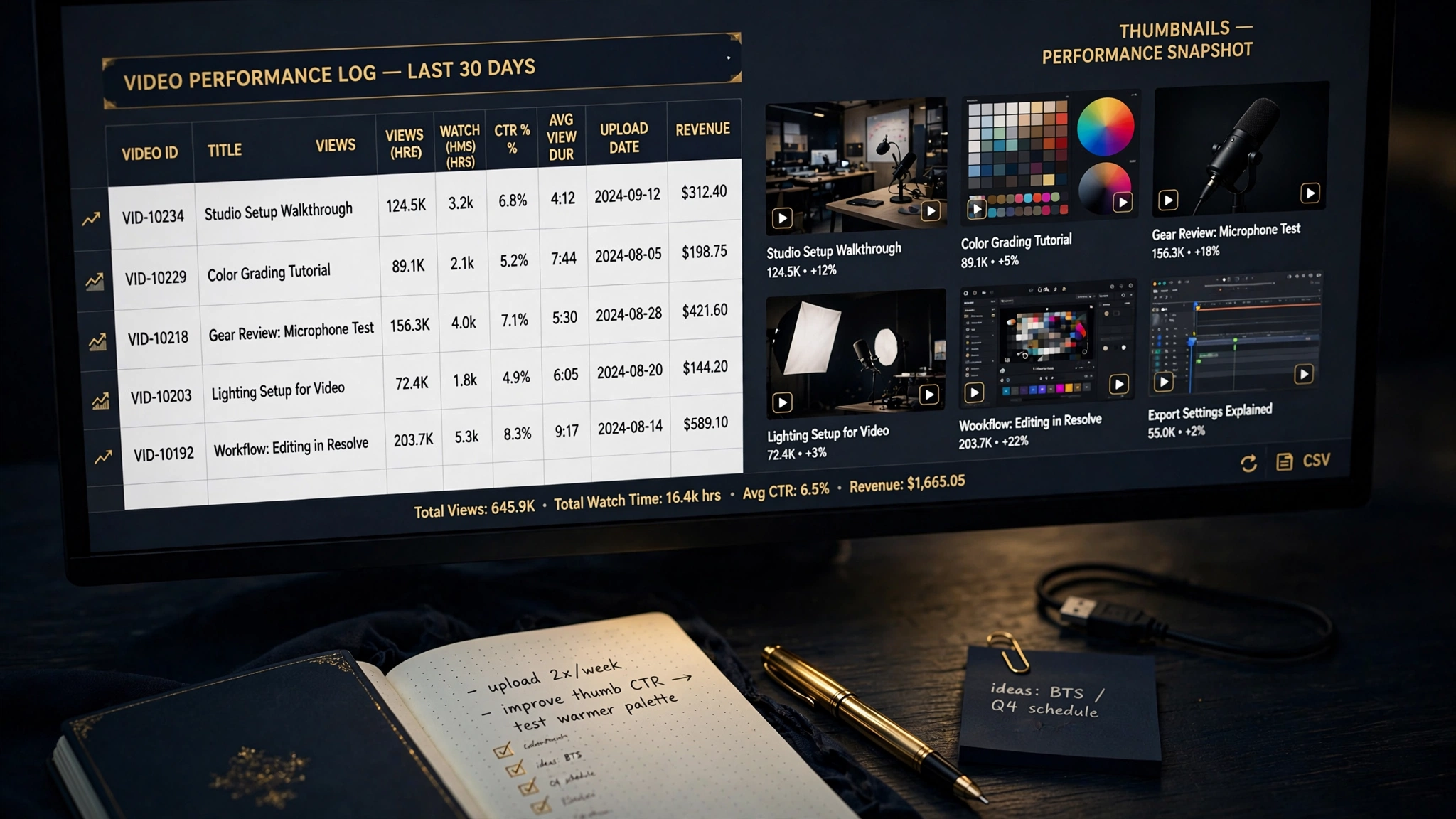
The Checkpoint Reviews
Every 25 videos, stop producing for one day and interrogate the log:
- At 25: Identify your top 3 videos by retention, not views. What do their topics and hooks share? Your next 25 skew toward that pattern. Kill your worst title formula entirely.
- At 50: One or two content pillars should be visibly outperforming the rest. Narrow toward them — channels find their niche by evidence around video 40–60 more often than by planning at video 0.
- At 75: Study traffic sources. If suggested/browse is growing, your packaging is working; if search dominates, your topics carry you — each diagnosis prescribes a different next 25.
- At 100: The full review. You’ll know your real niche, your real format, your real production speed, and whether your numbers justify Stage 2 investment (better tools, first contractor, second format). Decide from the log, not from mood.
What to Honestly Expect
Ranges, not promises: many committed channels finish 100 videos with a few hundred to a few thousand subscribers and watch hours still building toward monetization; some break out at video 30; some flatline and correctly pivot niche at the 50-checkpoint. Every one of those outcomes contains the information Stage 1 exists to produce. The only outcome that wastes the effort is quitting at video 14 with no log and no lessons — the default ending this system is designed to prevent.
Guard the input metric when the output metrics are quiet: videos published, on schedule, logged. That’s the scoreboard for the first 100. Everything else is weather. And protect the system socially, too: tell one person your publishing schedule and report to them weekly. A system with a witness survives the month-two motivation dip that quietly ends most channels — accountability is a production tool, not a personality trait.
Produce in batches. Log everything. Review at the checkpoints and obey the data. The creators who reach video 100 with a system are rarely the most talented ones who started — they’re the ones whose process made quitting harder than continuing. And when the catalogue starts paying, the Financial Calculators hub is where that revenue gets a plan instead of a splurge. Video one is this week.
