
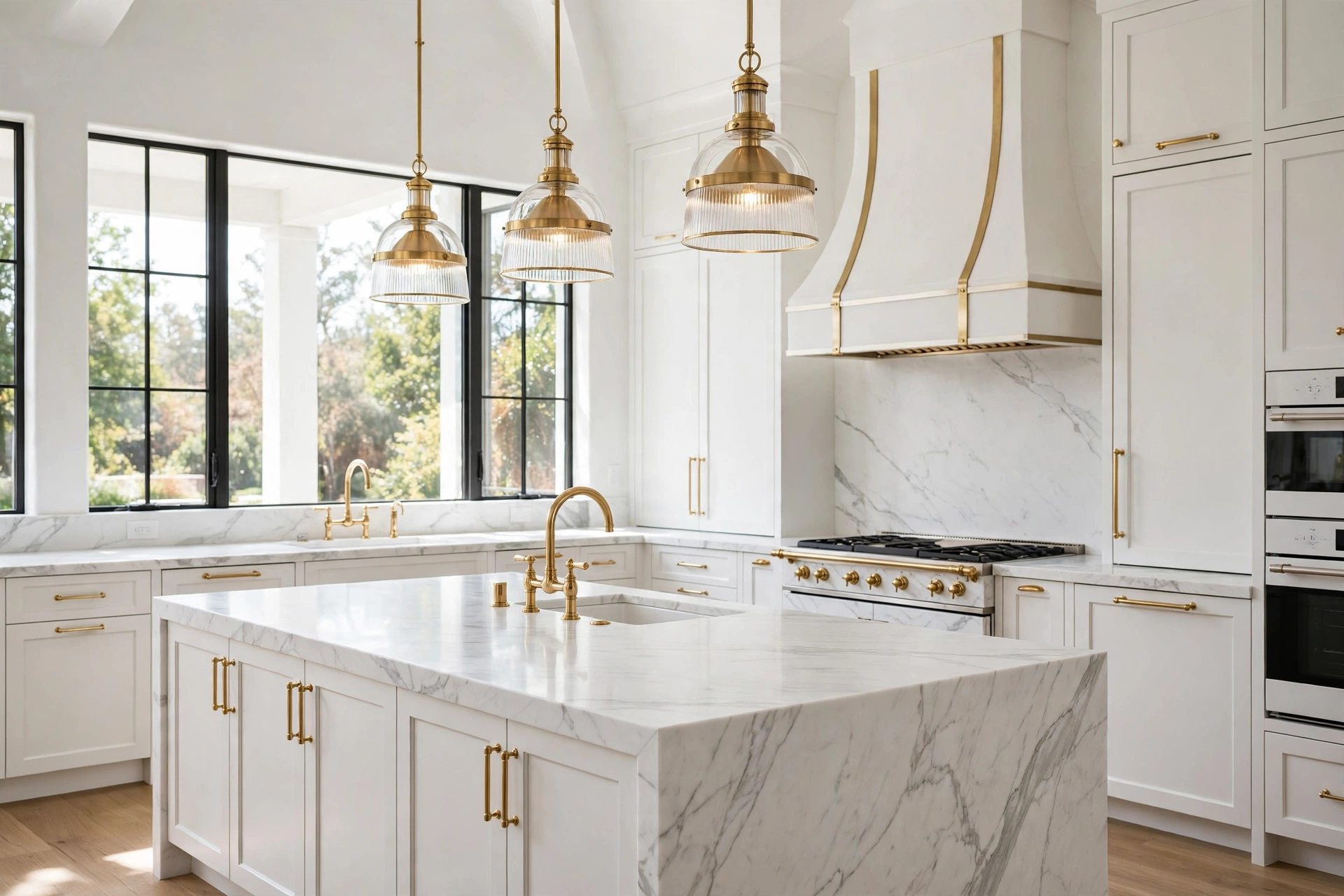
The most luxurious kitchens share a paradox: they look like almost nothing is happening in them, yet they are the hardest-working rooms in the house. Counters are clear, handles gleam, a single bowl of lemons does all the talking. Underneath that calm is ruthless planning — storage sized to real habits, materials chosen to age gracefully, and a strict rule that only the beautiful and the daily earn a place on show.
Marble and brass are the headline act in many of these rooms, and this guide explains how to use both without creating a high-maintenance headache. But the deeper lesson is the third element in the title: zero clutter. Get that right and even a modest kitchen feels expensive. Get it wrong and no stone slab will save it. For more rooms in the same spirit, browse Millionaire Lifestyle.
The Layout Comes Before the Marble
Luxury starts with movement. A good kitchen lets two people cook, unload shopping and make coffee without a dance of apologies. The classic work triangle — hob, sink, fridge — still matters, but modern luxury kitchens think in zones: a cooking zone, a washing zone, a prep zone on the island, and a drinks or breakfast zone that guests can use without entering the cook’s path.
Islands earn their fame here. A well-sized island gives you prep space facing the room, casual seating, and storage on both sides. Leave generous walkways around it; cramped aisles feel cheap no matter what the counter is made of. If your kitchen cannot fit an island, a peninsula or even a slim freestanding table can create the same social centre. Pendant lights above mark the island as the room’s hearth — choose two or three, hung low enough to glow rather than glare.
Marble, Honestly
Marble’s appeal is movement: no two slabs share the same veining, so a marble counter or splashback makes a kitchen unmistakably one of one. Its honesty matters too. Real marble is porous, it can etch when acids like lemon or vinegar sit on it, and it will gather small marks over years of use. Many owners consider that patina part of the beauty — the stone records the meals. Others prefer certainty.
Where marble gives the most
If budget or maintenance worries limit you, use marble where it is seen most and stressed least: a full-height splashback, the island top if you are a careful cook, or a single statement section such as a pastry slab set into the counter. Large-format porcelain that mimics marble is a legitimate alternative for the rest — durable, stain-resistant, and convincing at a glance — as long as you choose a pattern with soft, natural veining rather than a repeated print.
Seal real marble as directed, wipe spills promptly, and use boards and trivets without apology. A kitchen that is too precious to cook in has missed the point of luxury entirely.
Pairing stone with cabinetry
Marble looks richest against quiet cabinets: warm white, deep green, ink navy, or natural oak. High-gloss cabinets fight the stone for attention; matte and satin finishes let the veining lead. Repeat the stone once elsewhere — a windowsill, a small shelf, the pantry floor — and the room feels composed rather than decorated.
Brass: The Warm Metal That Ties It Together
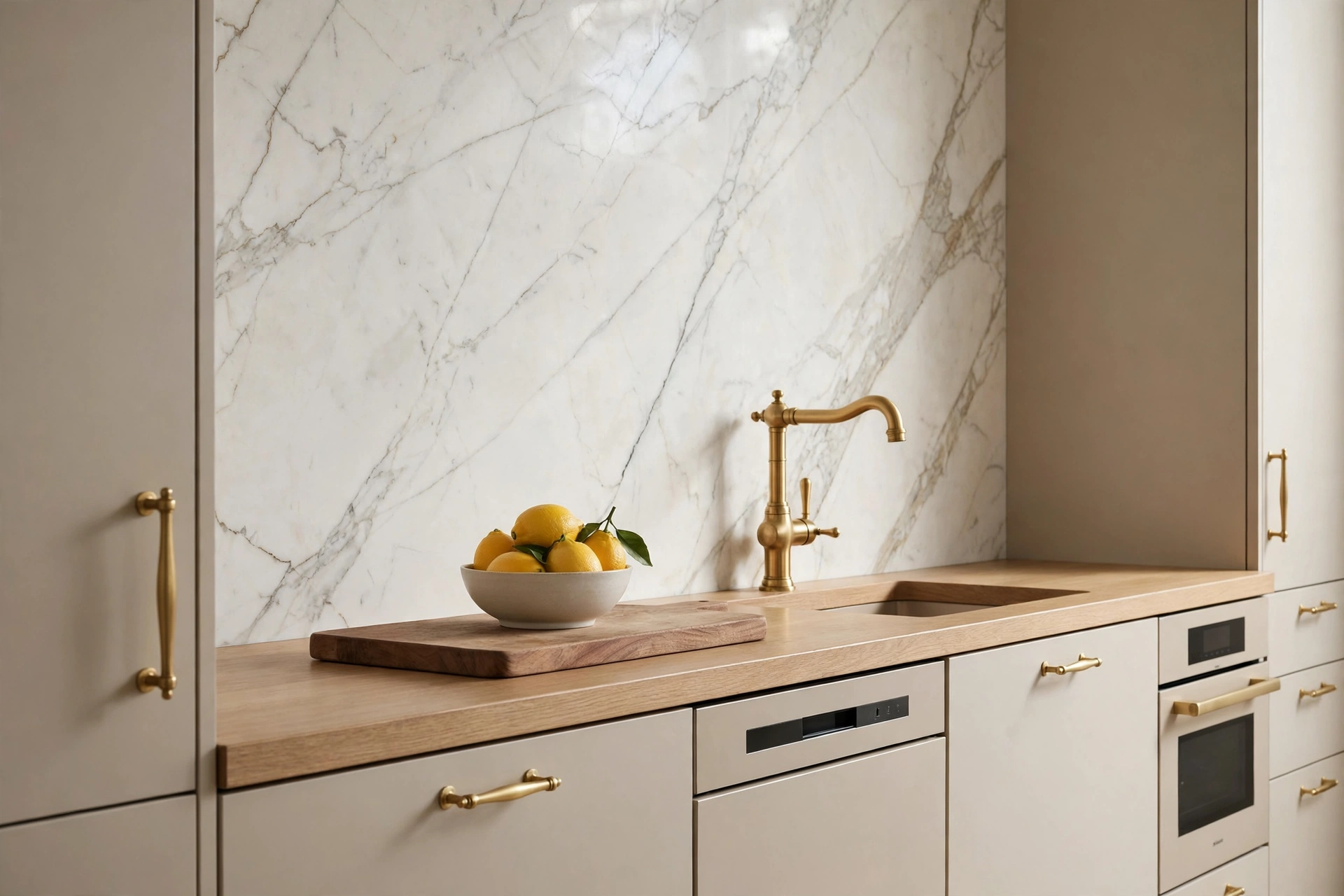
Brass is marble’s natural partner because it warms the stone’s coolness and flatters wood. The key is choosing a finish and repeating it with discipline: taps, cabinet handles, pendant details, perhaps the rail for utensils or the trim on the cooker. Two or three appearances read as a theme; six different gold-ish finishes read as an accident.
Unlacquered brass changes over time, darkening where hands touch it. Many people love that living finish in a kitchen, where touch is constant. Lacquered or brushed brass stays more uniform and suits owners who prefer their metal calm. Either way, keep other metals quiet — stainless appliances are fine, since they read as neutral, but avoid adding chrome taps to brass handles in the same sightline.
Scale matters. Long bar handles suit wide drawers, knobs suit smaller cabinets, and oversized statement taps deserve a deep, equally confident sink. If you rent or are testing the look, brass handles and a tap are reversible first steps before any stone is cut.
Zero Clutter Is a Storage Plan, Not a Personality Trait
Clear counters are not the result of being a tidy person. They are the result of giving every object a hidden home with room to spare. Plan storage by confessing your real habits first.
Hide the daily machines
Coffee machines, kettles, toasters and blenders cause most counter clutter. An appliance garage — a cabinet with a lift-up or pocket door and sockets inside — keeps them plugged in, usable in seconds, and invisible the rest of the day. A deep drawer under the coffee station holds pods, beans and mugs together. Microwaves belong in an island cabinet or a tall unit at a safe height, not squatting on the worktop.
Drawers over cupboards
Deep drawers beat low cupboards everywhere: pans stack in one layer, plates stand in pegged drawers, and nothing disappears into a dark back corner. Add a narrow pull-out for oils and spices beside the hob, a tray divider drawer for utensils, and a dedicated, ventilated spot for bins and recycling so waste never becomes a visible bag in the corner. Inside the sink cabinet, a simple organiser keeps cleaning supplies upright and contained.
The pantry principle
Whether it is a walk-in larder or a single tall cabinet, decant dry goods into uniform jars and baskets, label them, and group by meal rather than by shopping trip. A pantry you can read at a glance prevents duplicate buying and keeps counters free of half-open packets. As an illustrative example, one tall cabinet with five shelves, consistently organised, can absorb the clutter of an entire small kitchen.
Lighting and the Evening Kitchen
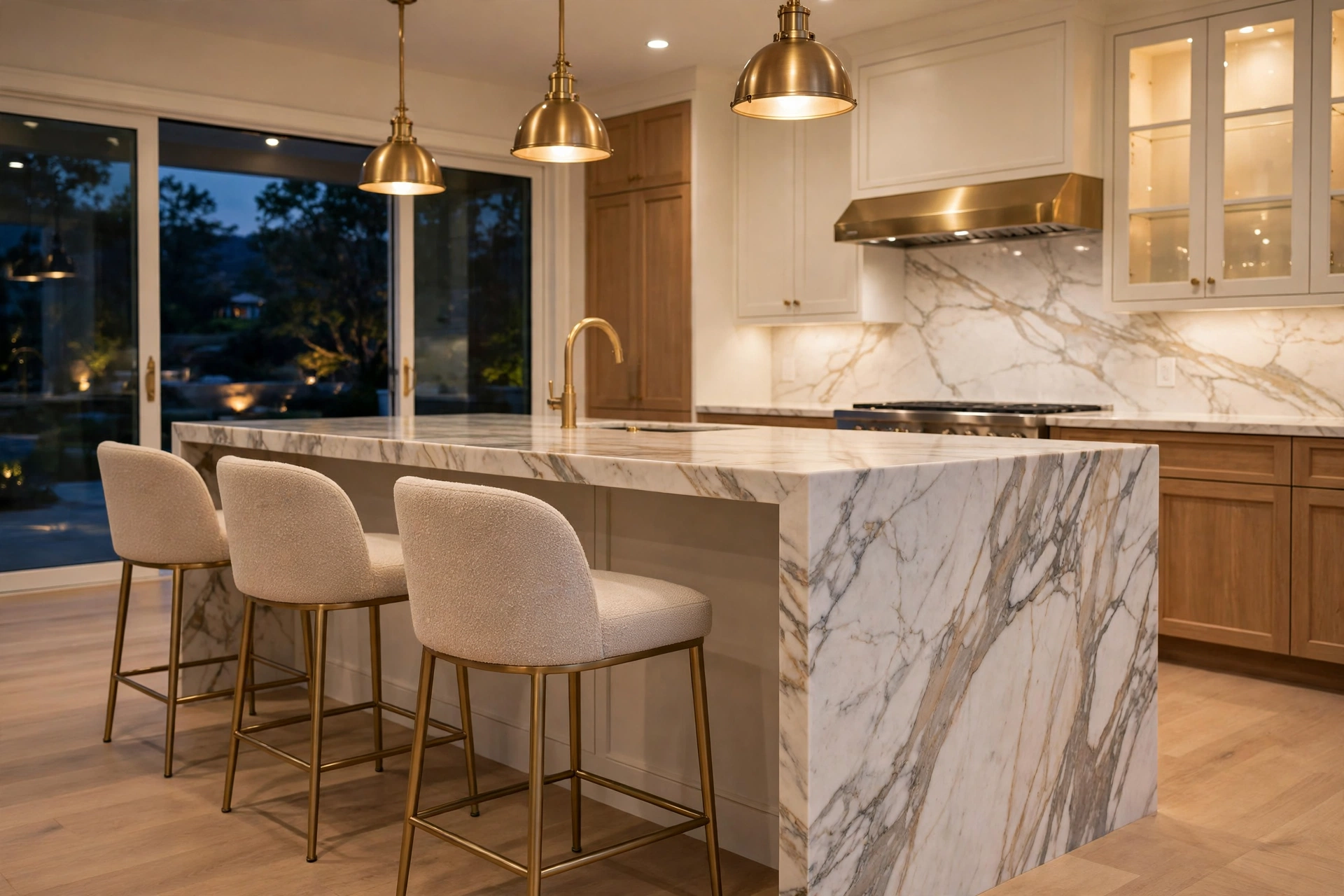
Luxury kitchens are lit in layers, just like hotel bedrooms. Task lighting under wall cabinets should wash the worktop evenly, with no dark gap between hob and sink. Ambient ceiling light fills the room, pendants give the island its glow, and a low accent — inside glass cabinets, or a small lamp on a counter corner in an open-plan space — lets the kitchen settle into the evening without feeling like a laboratory.
Put lights on separate circuits or dimmers. The cook needs brightness at noon; the same room at 9 p.m. wants warmth. Bulbs with faithful colour rendering also matter here, because they make food look like itself — a small detail caterers guard fiercely.
Styling: The Rule of One
With counters cleared, styling becomes easy — and restraint is everything. Follow the rule of one: one bowl of fruit or one vase of branches on the island, one beautiful board leaning by the hob, one set of matching canisters only if they are genuinely used daily. Cookbooks belong in a small stack of two or three favourites, not a library. Linen tea towels in a quiet stripe add softness without noise.
Open shelves, if you have them, are a contract: matching glasses, plain white dishes, nothing chipped, nothing dusty. If that contract sounds tiring, choose closed cabinets and enjoy your freedom. Luxury is a kitchen that suits its owner’s real life, maintained without resentment.
Budgeting the Transformation in Stages
Few kitchens change all at once, and staged work often looks more considered. A sensible order is: declutter and storage inserts first, lighting second, handles and tap third, then stone and cabinet refinishing as the final, largest step. If you are weighing a bigger renovation, run the staged totals through the free financial calculators to compare paying in phases with financing — an honest comparison, made calmly, before any showroom visit sweeps you along.
The Kitchen That Stays Luxurious
Marble for character, brass for warmth, storage for silence. The formula is simple, but its power is cumulative: every object hidden, every surface clear, every material allowed to be itself. Cook in it daily, wipe the stone, polish nothing obsessively, and let the room gather the gentle evidence of good meals. That — not a showroom shine — is what a luxury kitchen actually feels like to live in.
