
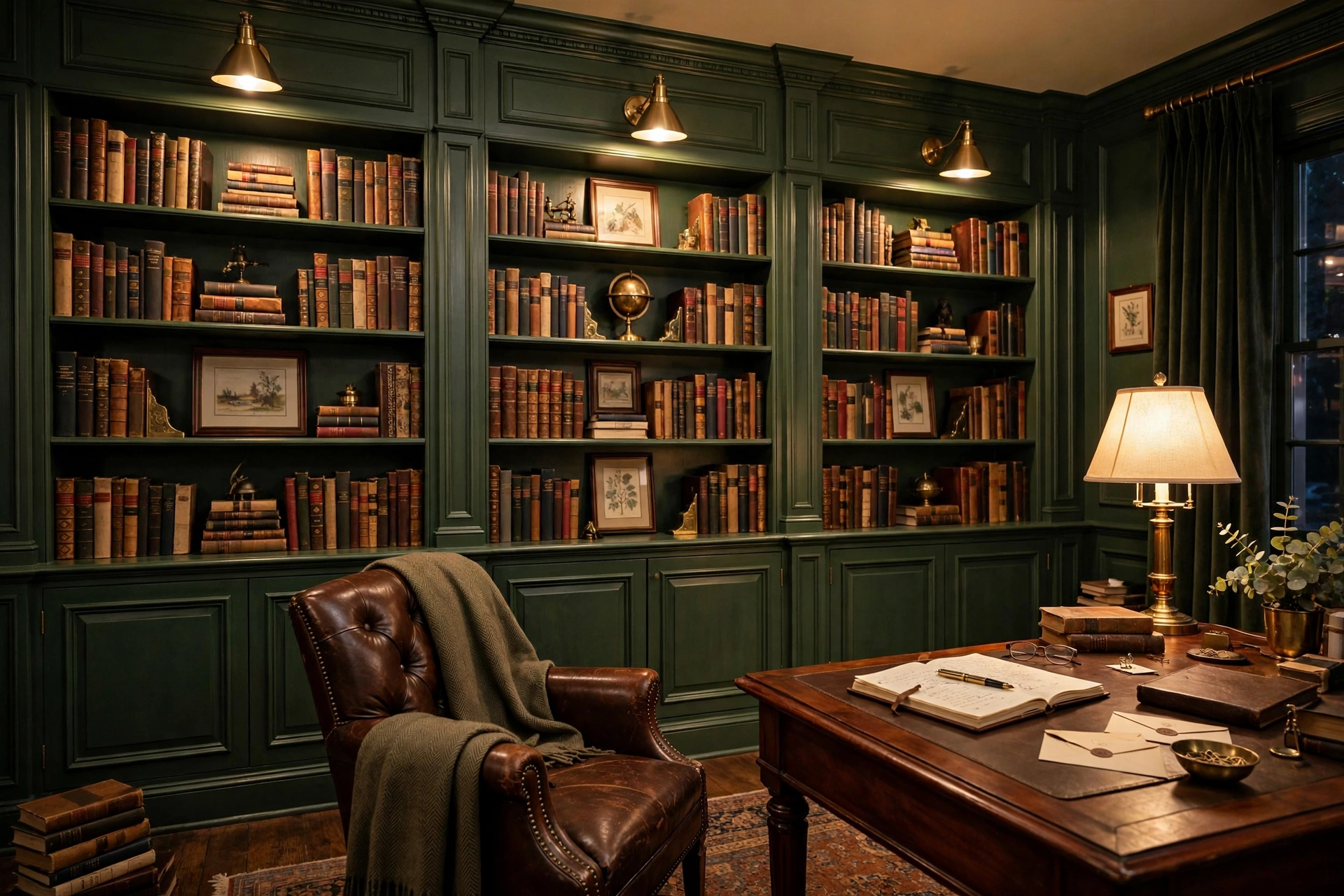
Some rooms impress you loudly, and some impress you slowly. A library wall belongs firmly to the second kind. Floor-to-ceiling books, warm timber or deep painted shelves, a leather chair worn soft by years of use, lamplight pooling over an open page — nothing in the scene is new, flashy or trying hard, and that is precisely its power. This is what people mean by old-money office energy: confidence without display, learning treated as furniture, and comfort built to last for decades. The wonderful part is that the feeling can be created honestly at many scales, from one wall of shelving in a home office to a single, perfectly judged reading corner in a living room. You do not need a vast collection to begin. You need order, warmth and patience.
Why Books Change a Room Like Nothing Else
Books do three jobs at once, which is why designers reach for them so often. Visually, hundreds of spines create texture, colour and rhythm that no wallpaper can match — a living pattern that rewards a long look. Acoustically, books are superb sound absorbers, which is why library rooms feel so hushed and why calls and conversation sound better in them. Emotionally, they signal a life being lived in the room. A shelf of real, read books — mixed heights, a few stacks lying sideways, one or two objects resting among them — tells a story about its owner that a styled, untouched display never can. That authenticity is the heart of the old-money effect. The aim is a working library, not a stage set, and visitors can always tell the difference.
Planning a Library Wall That Looks Built-In
The defining feature of a luxury library wall is that it reads as architecture, not furniture. Shelves run floor to ceiling and wall to wall, with a plinth at the base, a cornice or clean fascia at the top, and uprights spaced in a calm, regular rhythm. That fitted quality is what separates a library from a row of bookcases, and it can be achieved with custom joinery or, very convincingly, with standard bookcases fixed together, trimmed with mouldings, and painted as one piece. The well-known built-in illusion — identical units, gaps filled, everything caulked and painted in a single colour — works because the eye reads the whole wall as one construction.
Proportions, depth and colour
Shelf depth deserves thought before anything is built. Most books sit happily on shelves around 25 to 30 centimetres deep, while art books and storage boxes want more. Varying shelf heights — taller at the bottom for large volumes, standard in the middle, shorter near the top — looks intentional and makes shelving far more useful. A rolling ladder is the romantic finishing touch and genuinely practical for high shelves, but only add one where the wall is long enough to use it; on a short wall, a beautiful step stool is the more honest choice.
Colour sets the mood. Deep green, oxblood, inky blue and warm charcoal painted shelves create the classic, enveloping study feeling, especially with brass picture lights or sconces washing down the spines. Natural oak, walnut or mahogany-toned timber feels warmer and more traditional still. Pale shelves in cream or soft white suit brighter, more coastal rooms and let the books themselves provide the colour. Whichever direction you choose, commit fully — shelves, trims and the wall behind them in one finish — because half-painted compromises are what make built-ins look improvised. If you are phasing the project, perhaps joinery one year and lighting the next, the Financial Calculators hub can help you plan the stages alongside your other home priorities.
Arranging Books So Shelves Look Collected, Not Cluttered
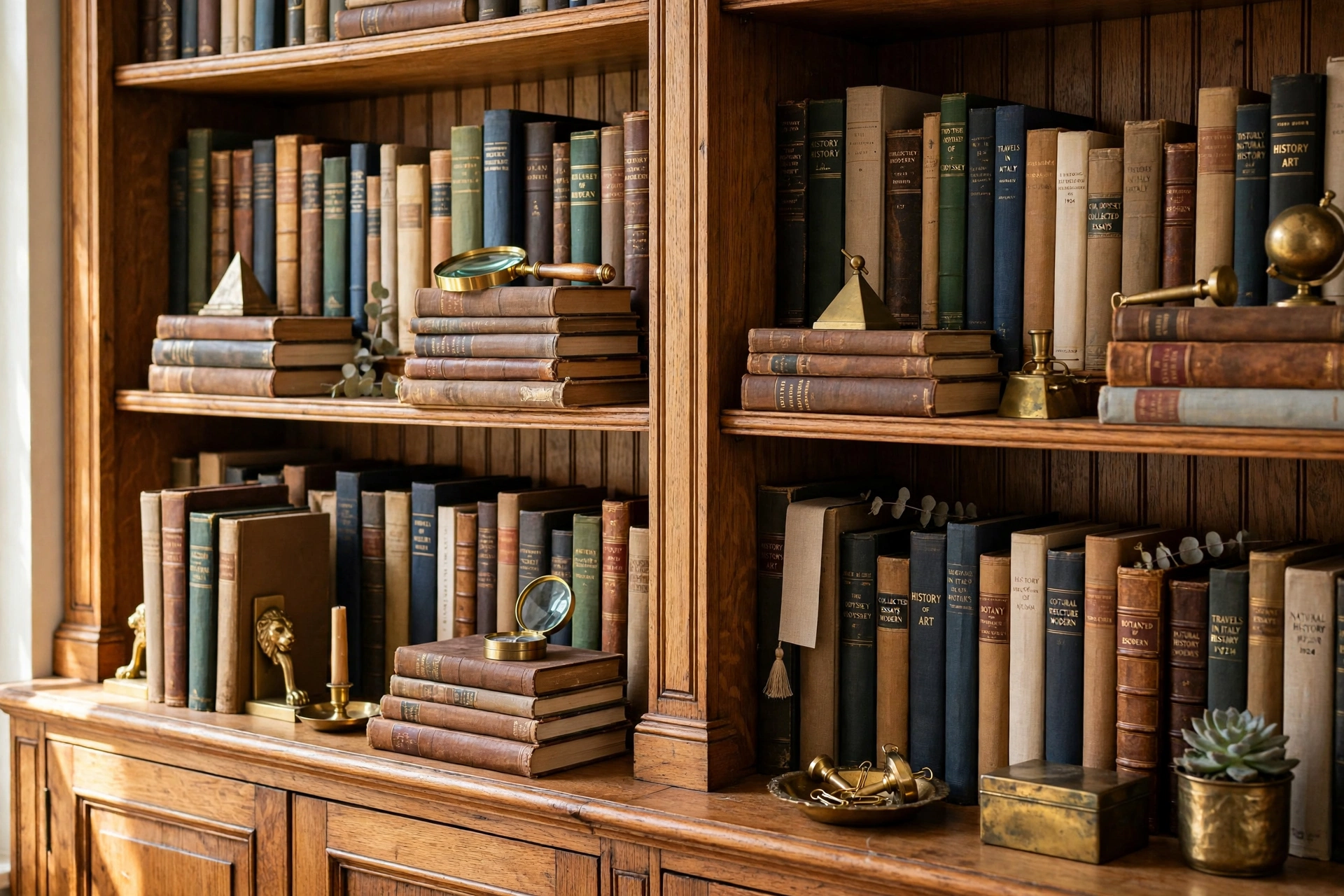
How books are arranged decides whether a library wall feels serene or chaotic. Start by grouping in a way that suits how you actually use them — by subject for a working library, roughly by size and tone for a more decorative one — and leave breathing room. Shelves filled to about three-quarters look abundant yet calm; shelves crammed edge to edge look like storage. Build in rhythm: vertical runs of books, then a horizontal stack, then a gap holding a single object. That alternation is the oldest stylist’s trick in the book, and it works every time.
Styling rules that keep it timeless
Keep objects few, weighty and meaningful: a brass magnifier, a stone bookend, a small framed print leaned against the spines, a ceramic bowl, a clock. Avoid tiny ornaments scattered along every shelf, which read as clutter at a glance. Face a few favourite covers outward where you have depth — it adds the gallery note bookshops use so well. Keep spines pushed to a consistent line near the shelf edge for that crisp, architectural look in formal rooms, or let depths vary naturally in a relaxed, lived-in library. Both are correct; mixing them randomly is not. Above all, edit. A library wall improves every time something is removed, and a shelf of books you genuinely value will always outshine a larger collection bought by the metre.
Lighting finishes the wall. Brass picture lights along the top, small sconces between sections, or discreet shelf lighting washing down each bay turns books into the room’s artwork after dark and makes the wall glow like a fireplace. Warm light is essential here — cool light on old paper and leather looks clinical and instantly breaks the spell.
The Reading Corner: One Chair, Perfectly Placed
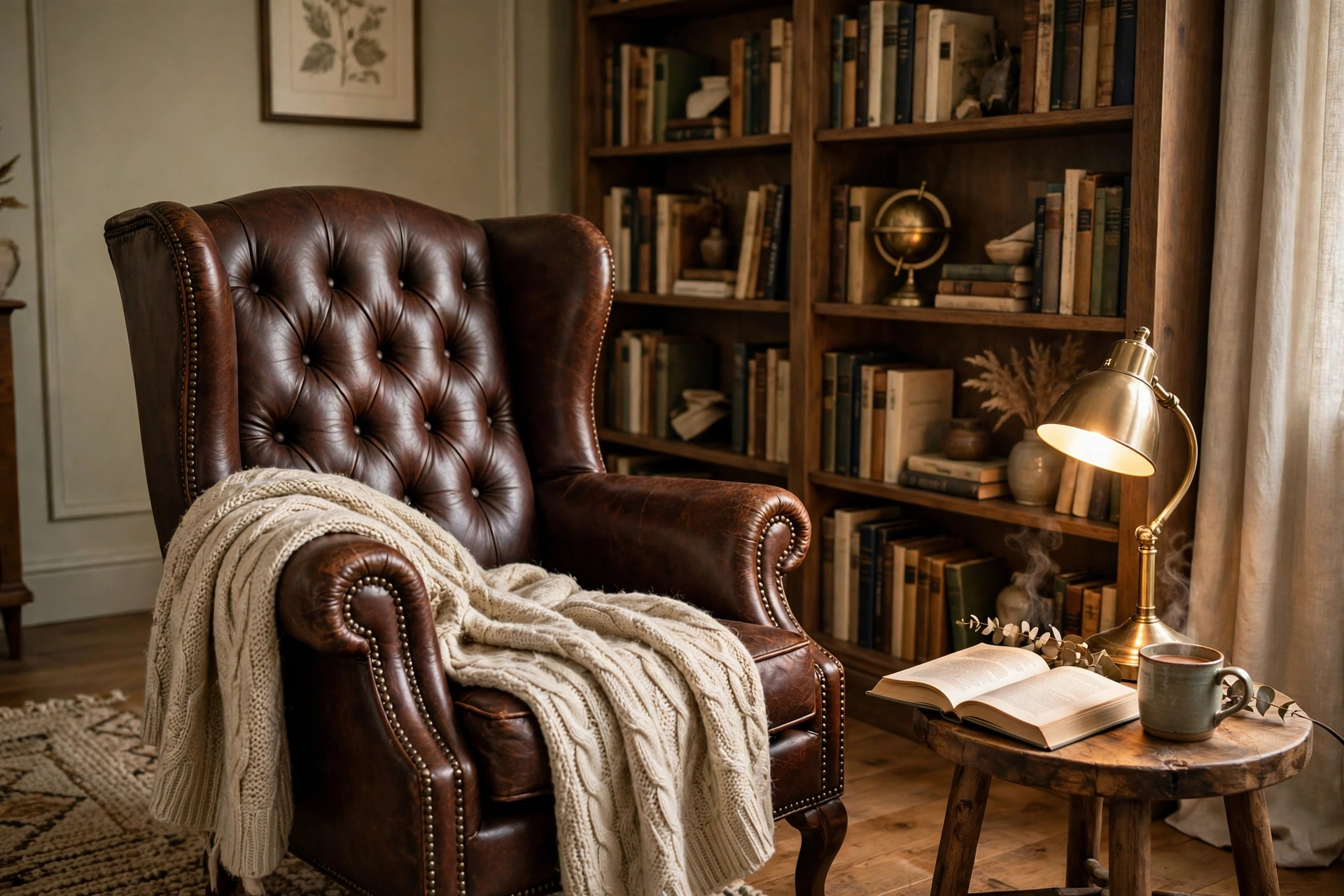
If a full library wall is not possible — or even if it is — the reading corner is where the luxury is actually lived. Its formula has not changed in a century because it is already perfect: one deeply comfortable chair, one small table within arm’s reach, one excellent lamp, and something soft underfoot. The chair should invite hours, not minutes — a wingback, a deep club chair or a generous armchair with a footstool, in leather that improves with age or a textured fabric in a deep, forgiving tone. Sit in it before you buy, and imagine chapter twenty, not chapter one.
Placement makes the corner. Tuck it beside the library wall, at an angle to a fireplace, or by a window with a garden view — somewhere with a reason to linger and a little shelter at your back. A corner near natural light serves daytime reading, while the lamp takes over in the evening. Keep the table just big enough for a book, a drink and your glasses. Add a throw in wool or cashmere tones, a cushion that supports the lower back, and a small shelf or basket for the current stack. The discipline is to protect this corner from becoming general storage. It holds what you are reading now, and nothing else. That clarity is why it stays inviting.
Blending Library Energy Into a Working Office
In a home office, the library wall earns its keep twice. Behind a desk it forms the most credible video-call background there is — real books, warm light, quiet depth — while the shelves themselves hold references, files and the tools of your work among the reading. Place the desk facing into the room with the library behind you, keep the reading chair in the corner for thinking and calls away from the screen, and the office gains that settled, established quality clients and colleagues register instantly, even through a camera.
Practical details protect the atmosphere. Keep everyday paperwork in closed cupboards at the base of the shelving, so open shelves stay bookish rather than administrative. Run cables for shelf lighting during installation, not after. Choose a desk lamp and reading lamp in the same family of finishes — brass is the classic partner to library shelves — so the whole room speaks one language. A Persian-style or deep-toned rug, a leather desk surface and one piece of serious art complete the old-money register without a single logo or slogan in sight.
Starting Small: The One-Shelf Method
You do not need to wait for the full wall. Begin with the books you own and one honest piece of shelving, arranged with the rhythm described above. Add the chair corner next, even in a living room or bedroom, and use it daily — the ritual builds the feeling faster than any purchase. Grow the collection slowly, from bookshops, travels and gifts, letting gaps on the shelves stand as invitations rather than problems to fill quickly. When the moment comes to build the full wall, you will already own the two things money cannot shortcut: a real collection, and the habit of reading in the room. Libraries built that way look inherited even when they are brand new, because in the ways that matter, they were earned.
That is the final secret of old-money office energy. It is not a style that can be installed in a weekend. It is the visible result of order, warmth and use, accumulated patiently — shelves that fit their wall, books that were actually read, a chair that fits its reader, and light kept warm and low.
For more timeless interiors, explore the Millionaire Lifestyle collection, with practical ideas you can adapt slowly and well to your own home.
