
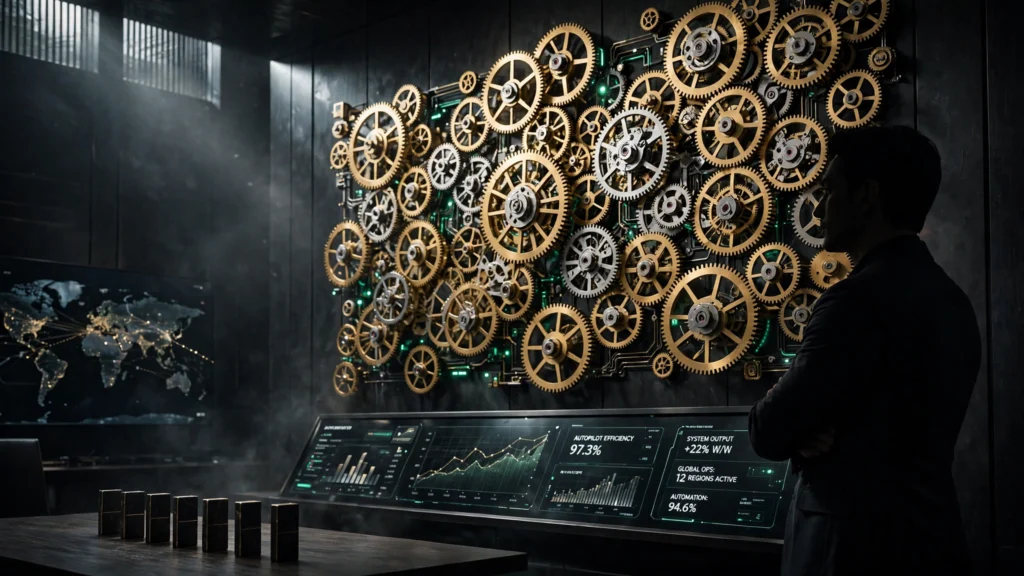
Motivation is a mood. Systems are machinery. In the systems vs goals debate, the wealthy think in systems; everyone else chases goals.
Moods are unreliable — they change with your sleep, your weather, your inbox. Machinery doesn’t care how you feel. It just runs. This is the quiet secret behind almost every person who seems impossibly consistent: they aren’t more motivated than you. They’ve just built machines that don’t require motivation.
The wealthy figured this out because they had to. You cannot run a company, a portfolio, or an empire on willpower. The scale is too big and the days are too long. So they stopped asking “how do I stay motivated?” and started asking a better question: “how do I design this so it works even on my worst day?”
Systems vs Goals: What It Means to Think in Systems
A goal is a destination. A system is the vehicle.
“I want to save $10,000” is a goal. “Every payday, 20% moves automatically to a separate account before I see it” is a system. Goals depend on you remembering, deciding, and resisting temptation — every single time. Systems make the right action the default, so willpower becomes irrelevant.
Here’s the mental shift: stop trying to become the kind of person who always makes good decisions. Instead, become the kind of person who designs environments where good decisions happen automatically. The first is a character project that fails under stress. The second is an engineering project that holds under stress.
This is how the rich operate at every level. They don’t rely on remembering to invest — money moves automatically. They don’t rely on feeling like working out — the trainer is booked and paid for. They don’t rely on discipline at the grocery store — the meals are planned. Everywhere you see effortless consistency, you’ll find a system underneath. This is what it looks like to think in systems: design the default once, then let the machinery run.
Where You’re Running on Willpower (and Losing)
Be honest for a moment. Where in your life are you currently depending on motivation to carry you? Most people have the same leak points:
Money. You “try” to save what’s left at the end of the month. There’s never anything left. This isn’t a discipline problem — it’s a systems problem. Mastering money discipline starts with automation, not austerity.
Time. You plan to “focus tomorrow” and then react to whatever screams loudest. Without a time system — time blocks, a shutdown ritual, a default calendar — your days get spent by other people’s priorities.
Health. You rely on feeling like exercising and eating well. Feelings lose to fatigue, stress, and convenience approximately 100% of the time over a long enough horizon.
Learning. You read “when you get around to it.” You never get around to it.
Notice the pattern: every one of these fails the same way. Willpower is a finite daily resource, and life spends it before you get to the things that matter. Systems don’t spend willpower at all.
The 5 Systems Every Wealth-Builder Needs
You don’t need fifty systems. You need five, built one at a time:
1. The money system
Automate the flow: income arrives, fixed percentages split instantly — savings, investing, bills, spending. The rule is simple and brutal: pay your future self first, automatically. What you never see, you never miss. Review monthly, adjust quarterly. This single system does more for wealth than any budgeting app ever will.
2. The time system
Your calendar is your real budget. Block your deep work like a non-negotiable meeting. Batch shallow tasks — email, errands, admin — into fixed windows instead of letting them fragment your day. End each day by planning tomorrow’s top three. Treating your time as currency means giving it the same protection you’d give cash.
3. The energy system
Wealth means nothing without the health to enjoy it. Systematize the basics: a consistent sleep window, movement scheduled like work, meals planned rather than improvised. You don’t need an athlete’s regimen — you need defaults that survive busy weeks.
4. The learning system
Thirty minutes daily, anchored to an existing habit, with a notebook for capture. One topic per quarter, studied deeply instead of ten topics skimmed. Systems turn “I should learn more” into “I learn every morning at 7.”
5. The decision system
Decision fatigue is real, and the wealthy minimize it ruthlessly. Create personal policies that pre-decide recurring choices: “I don’t check email before 10am.” “Purchases over $200 wait 48 hours.” “Every opportunity gets scored against my one goal.” Fewer decisions, better decisions.
How to Build Your First System This Week
Don’t build all five at once — that’s a motivation project wearing a systems costume. Pick the one area leaking the most right now and follow this sequence:
- Name the failure point. Where does willpower keep losing? Be specific: “I never save” is vague; “money sits in checking and gets spent” is a diagnosis.
- Design the default. What would make the right action automatic? Auto-transfer, calendar block, pre-commitment, environment change.
- Remove one decision. Every system should eliminate at least one recurring choice. Fewer forks, fewer failures.
- Set a review date. Systems decay. Put a 30-day check on your calendar to ask: is it running? What’s jammed? Fix the machine, don’t blame yourself.
Taking massive action daily gets easier when action is the default rather than a daily negotiation with yourself. Systems are how action becomes identity.

Day 65 Challenge
Pick your single biggest willpower leak — money, time, energy, or learning. Design one system for it today using the four steps above, and put it in motion before the week ends. One working system beats five perfect plans. Learning to think in systems starts with this single default.
Key Takeaways
- Goals are destinations; systems are vehicles. Motivation fails under stress — machinery doesn’t.
- Stop trying to become someone with endless willpower; become someone who designs environments where good decisions are automatic.
- Audit your leaks: money, time, health, and learning are where willpower quietly loses every day.
- Build the five core systems one at a time: money, time, energy, learning, and decision systems.
- Start with your biggest leak, design the default, remove one decision, and review in 30 days — then let the machine run.