
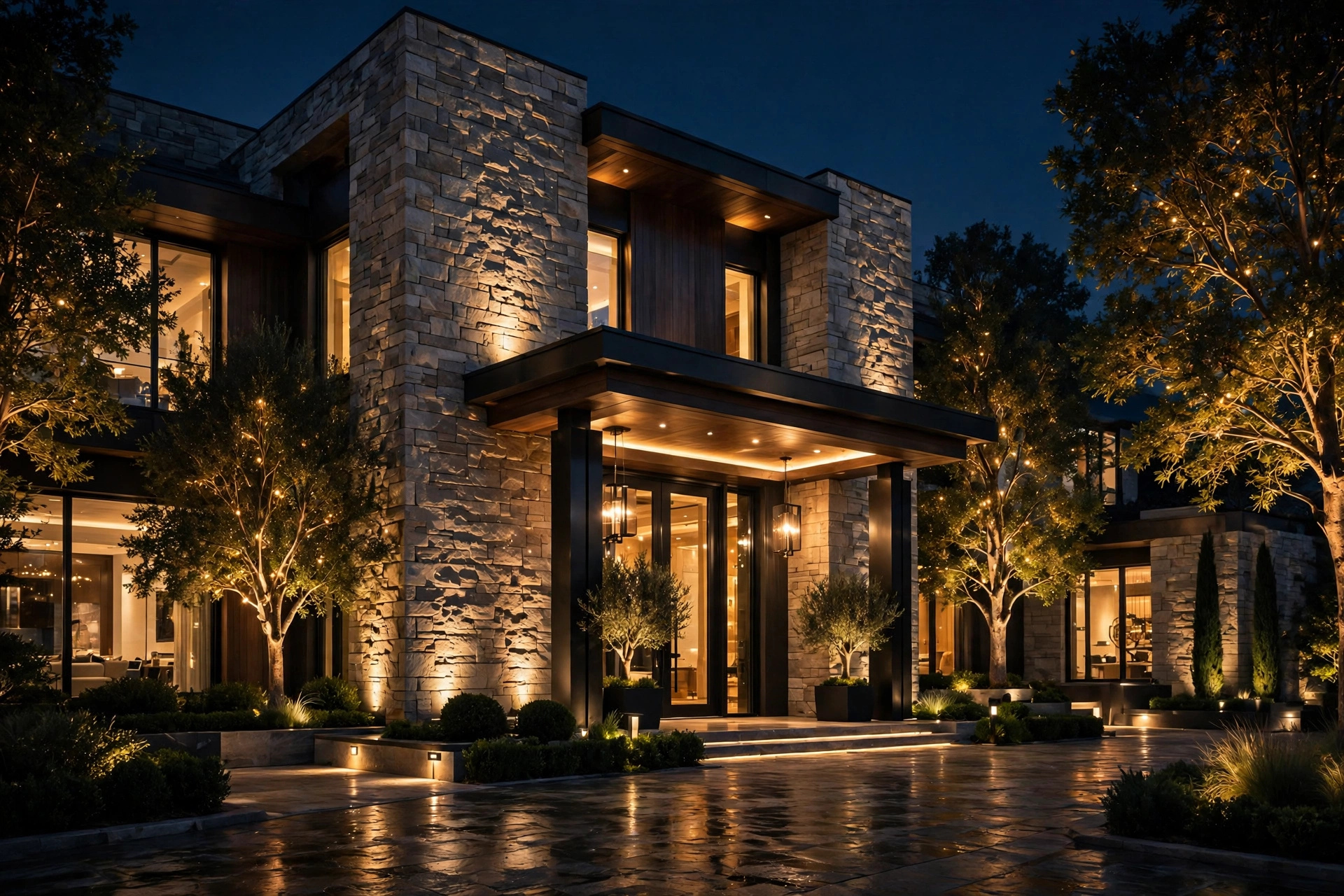
Every home has two faces: the one you see during the day, and the one that appears after dark. Most houses disappear at night into a flat, grey silhouette, lit only by a single harsh bulb beside the front door. Luxury homes do the opposite. After sunset they come alive — stone glows warmly, trees become sculptures, the entrance feels like the arrival at a boutique hotel, and windows spill soft golden light across the garden. The difference is rarely the house itself. It is facade lighting: a planned layer of exterior light that reveals texture, depth and proportion. The good news is that this is one of the most achievable luxury upgrades there is, because light can transform architecture you already own.
Why Night Lighting Changes Everything
During the day, sunlight models a building for free, casting shadows that show depth and texture. At night, without designed lighting, that modelling vanishes. A single bright fitting makes things worse, creating glare in visitors’ eyes while leaving the rest of the facade in darkness. Designed facade lighting restores the modelling deliberately. It picks out the materials worth showing — a stone wall, a timber screen, a beautifully proportioned entrance — and lets the rest fall into shadow. Contrast is the whole secret. Expensive-looking night facades are never evenly lit. They are selectively lit, with pools of warmth, gentle gradients and deliberate darkness in between.
There is a practical dividend too. A well-lit approach is safer to walk, easier for guests and deliveries to find, and far more welcoming to come home to. The aim is a house that looks composed and cared for from the street, every single evening, without any effort after the system is installed.
Start With the Architecture, Not the Fittings
Before choosing a single light, walk across the street at dusk and really look at your home. Which parts deserve emphasis? Perhaps a stone chimney, a pair of columns, a mature tree, an interesting roofline, or the texture of brick or render. Which parts should disappear? Utility areas, bins, plain side walls and awkward extensions are best left in shadow. Luxury facade lighting is an editing exercise: light the best three or four features, and resist the urge to illuminate everything.
The three layers of exterior light
Professionals think in layers, and borrowing that structure keeps a scheme coherent. The first layer is architectural light: fittings that graze, wash or silhouette the building itself. The second is landscape light: trees, planting, garden walls and water, which give the house a setting rather than leaving it floating in blackness. The third is functional light: the entrance, steps, path and driveway, designed for safe movement but styled to match the other two layers. When all three layers share the same warm colour temperature and a similar level of restraint, the whole property reads as one designed place.
The Core Techniques, Explained Simply
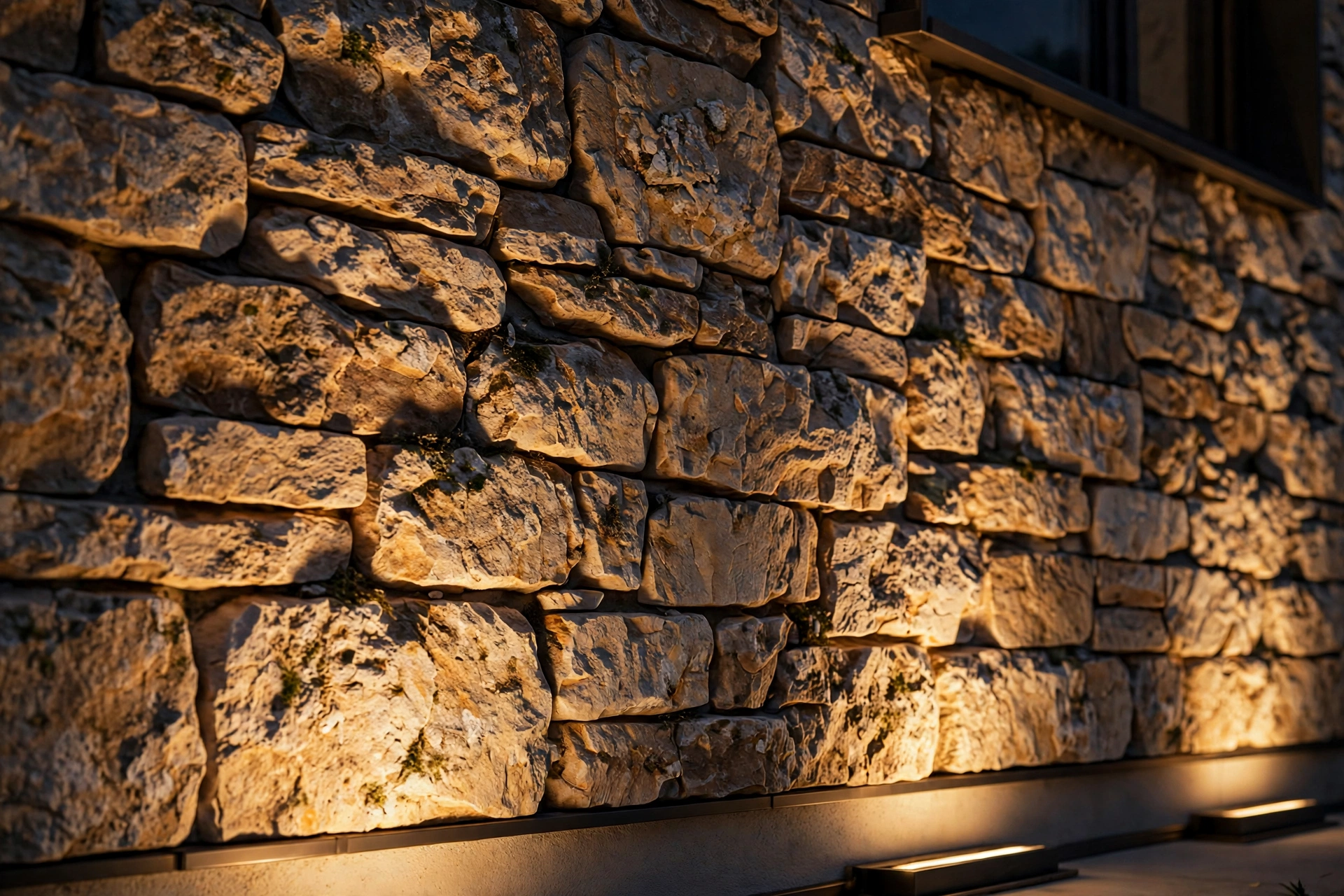
You only need a handful of techniques to cover almost any home. Uplighting places a fitting at ground level aimed upwards, ideal for trees, columns and textured walls, where the rising light exaggerates height and drama. Wall washing floods a flat surface evenly from a short distance away, giving render or stone a soft, expensive glow without hot spots. Grazing is the opposite: the fitting sits very close to a textured surface so light skims across it, making stone, brick or fluted panels look deeply three-dimensional. Downlighting from eaves or a tree canopy mimics moonlight and is the most natural-looking way to light paths and terraces. Silhouetting places light behind an object — a sculptural tree or screen — so it reads as a dark shape against a lit wall. Backlighting and step lighting handle the details: a glow behind house numbers, under a handrail, or within each step turns necessary features into design moments.
Choosing colour temperature and brightness
Warm light is non-negotiable for the expensive look. Fittings in the warm range — the golden tone associated with candlelight and traditional lamps — flatter stone, brick, timber and planting, and they match the warm light glowing from inside the house. Cold, blue-white light belongs to car parks and security yards; it flattens materials and instantly cheapens a facade. Brightness needs the same restraint. Exterior lighting should be noticeably dimmer than most people first choose. Your eyes adapt to darkness quickly, so gentle light goes a long way, and dim, layered schemes look richer than one powerful floodlight. If a fitting can be seen glowing from inside the house or dazzles you on the approach, it is either too bright or aimed badly.
Lighting the Entrance Like a Hotel Arrival
If budget forces you to choose one area, choose the entrance. It is where every arrival is judged. Frame the front door with a pair of wall lights at comfortable height, or a single statement lantern on a larger door, and make sure the light falls warmly on faces rather than shining down harshly from above. Add a soft wash over the house number and door furniture so brass, bronze or black hardware catches the light. Light the path or steps with low, glare-free fittings that show the way without turning the approach into a runway, and consider a lit feature on one side — an olive tree in a large pot, a stone sphere, a clipped hedge — to give the arrival a focal point.
Porches and porticos deserve ceiling light that pools gently rather than a bare bulb. Where there is an overhang or soffit, recessed downlights create the clean, architectural look associated with modern luxury homes. Whatever you choose, put the entrance on the same timer or smart control as the rest of the scheme so the welcome is automatic. Coming home to a lit entrance every night is a small daily pleasure that quickly feels essential. When planning the spend, it helps to treat facade lighting as a staged project — entrance first, main facade second, garden third — and you can map those stages against other home improvements in the Financial Calculators hub.
Trees, Gardens and Water: The Supporting Cast
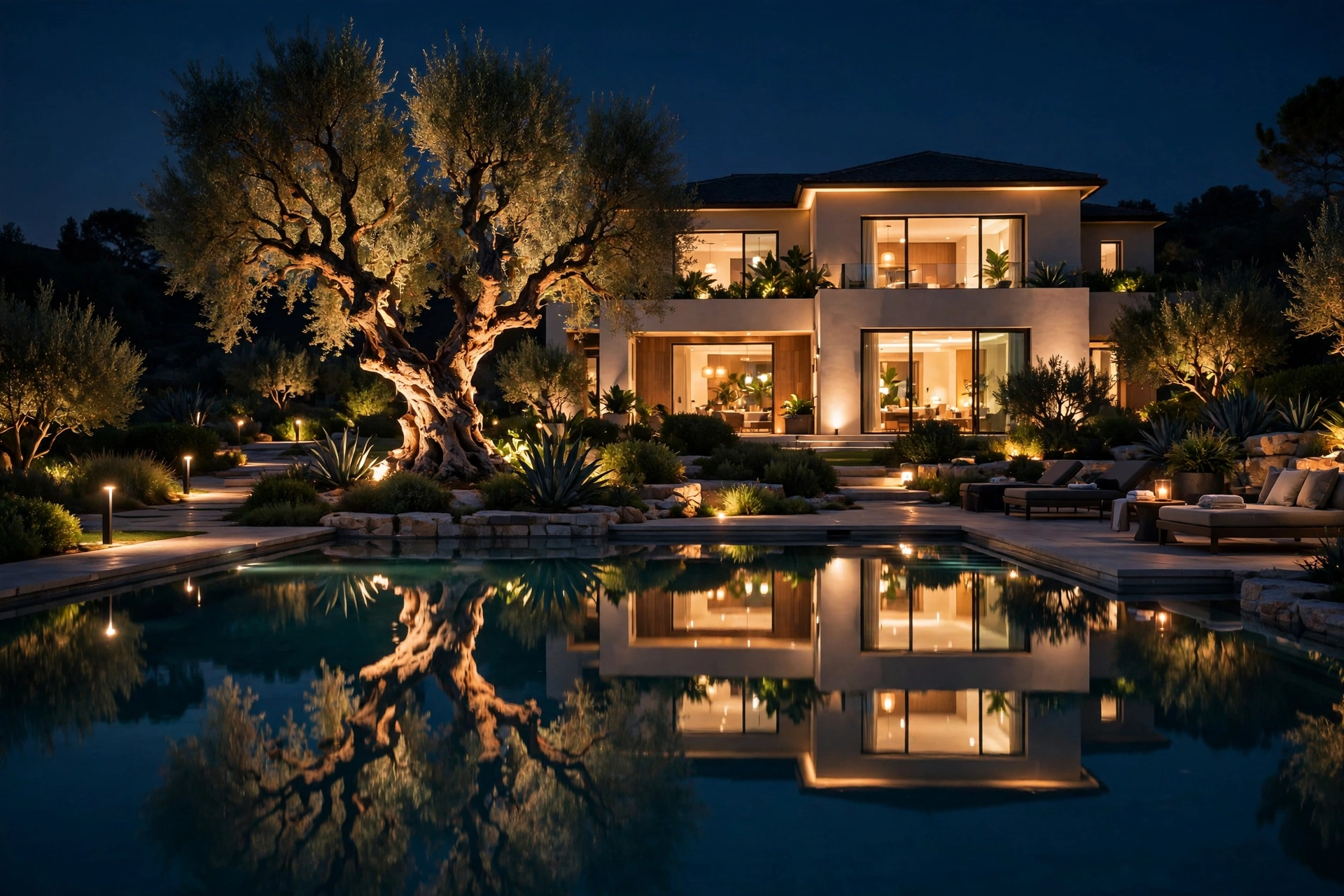
A lit house in an unlit garden looks like a stage set. Landscape lighting completes the picture and, because planting is forgiving, it is where beginners get the most dramatic results. Uplight one or two specimen trees from close to the trunk so the canopy glows from within. Wash a garden wall or hedge to create a luminous backdrop that makes the lawn feel deeper. Pick out a sculpture, bench or pergola with a single focused beam. Keep fittings hidden in planting during the day — black or bronze spike lights disappear among leaves — and bury or neatly pin cables so nothing looks temporary.
Water multiplies light beautifully. A lit pool or pond reflects the facade and doubles the effect of nearby fittings, while a gentle glow turns water itself into a design feature. Keep water lighting soft: bright blue reads as municipal swimming pool; warm, dim light reads as private resort.
Controls, Timers and Running Costs
Luxury facade lighting is automatic. Astronomical timers and smart controls switch the scheme on at sunset and off at a set hour, adjusting themselves through the seasons, so the house looks its best every evening without anyone remembering a switch. Many owners run a full welcome scene until late evening, then drop to a softer overnight layer — entrance and path only — which saves energy and respects neighbours. Modern LED fittings use very little power compared with older halogen systems, and quality fittings with replaceable, sealed optics last far longer in wet weather than cheap solar spikes, which rarely produce the warm, consistent light this look requires. Think of solar lights as temporary markers, not as the scheme itself.
Installation quality matters as much as fitting choice. Exterior electrics should be installed properly, with fittings rated for outdoor use and connections protected from water. If you are landscaping anyway, lay conduit and cable then — adding infrastructure while the ground is open is far simpler than retrofitting it later.
Mistakes That Make Lighting Look Cheap
The fastest way to ruin a facade is symmetry without thought: a row of identical bright uplights along every wall, evenly spaced like an airport. Real luxury schemes vary the rhythm, following the architecture instead of a measuring tape. The second mistake is visible glare — fittings you can see the bare bulb of from the street. Shield every source so you see the effect of the light, never the light itself. The third is mixing colour temperatures, with warm porch lights beside cold white path lights. Choose one warm temperature and use it everywhere. Finally, avoid lighting from only one direction. A facade lit solely from the ground looks theatrical; combining low uplights with gentle downlight from eaves gives the natural, settled look of a home that was designed to be seen at night.
Start small if you need to: the entrance, one architectural feature and one tree, all warm, all on a timer. Live with it for a month and you will quickly see where the next layer belongs. That patient, layered approach — rather than a single bright gesture — is exactly how expensive homes get their after-dark glow.
For more high-end finishes inside and out, explore the Millionaire Lifestyle collection, with practical ideas you can adapt to your own house and budget.
