
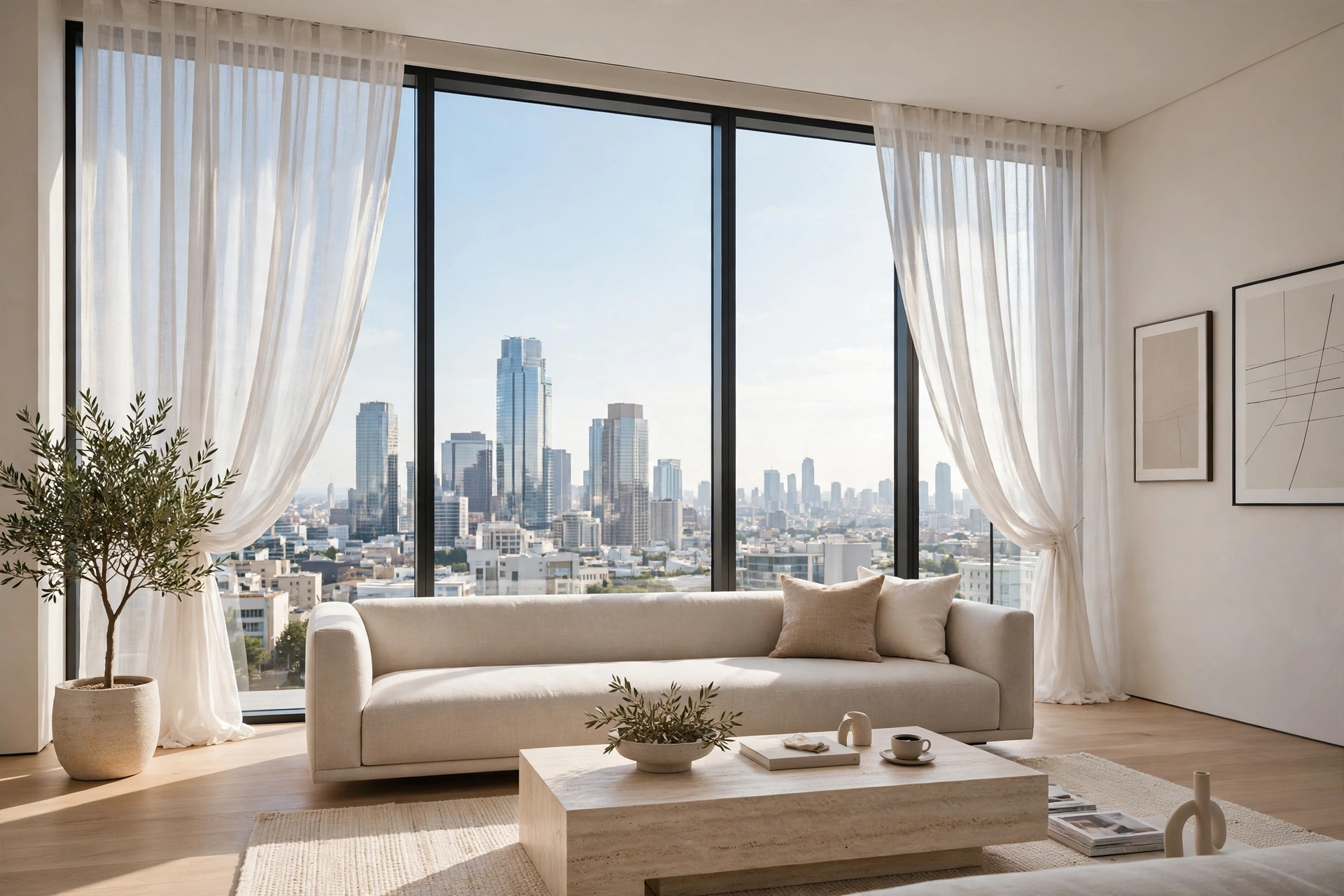
Floor-to-ceiling windows change every decorating decision in a room. The view becomes the largest piece of art you own, the light behaves differently at every hour, and furniture that would look perfect against a solid wall can look lost — or block the very thing you paid for. Decorating with a skyline view is therefore less about adding more and more about editing: keeping sightlines open, managing sun and privacy with grace, and choosing pieces that hold their own against a backdrop that never sits still.
Whether your glass faces a city skyline, water, or rooftops and trees, the principles below are the ones designers return to again and again.
Rule One: Protect the Sightline
Stand at the door of the room and look toward the glass. Everything you place between you and that view should either be low, transparent, or deliberately framing it. This single test prevents most mistakes.
Keep furniture below the horizon line
Low-profile sofas and chairs — with backs that sit well below the window’s mid-point — preserve the panorama and, counterintuitively, make ceilings feel higher. In dining areas, a table is naturally low enough; choose chairs with slim or open backs so the view reads through them. Beds in view-facing bedrooms are often placed with the headboard on an interior wall so you wake facing the glass, with low footboards or none at all.
Glass and acrylic pieces earn their place here: a glass coffee table or console keeps the eye moving to the view instead of stopping at the furniture. Use them sparingly — one transparent piece per zone is enough, and remember that glass shows dust and fingerprints in strong light, so it suits households at peace with a quick daily wipe.
Arrange in islands, not against the glass
Pull seating away from the windows into a conversational island anchored by a rug. This creates a walkway along the glass — wonderful for standing with a morning coffee — and stops sofas from bleaching in direct sun. The gap also makes window cleaning and curtain operation effortless, which you will appreciate monthly.
Managing Light: Sheers, Blinds, and Glare
Uncontrolled sun is the enemy of comfort and of your furnishings. Ultraviolet fades fabrics, heat builds up behind large glass, and glare can make a beautiful room unusable at certain hours. The luxury solution is layers, each doing one job.

Sheer curtains are the workhorse. Hung from ceiling to floor, in a soft white or warm neutral, they diffuse harsh light into a glow, give daytime privacy, and add the gentle movement that makes tall windows feel romantic rather than corporate. The trick is fullness — generous fabric, not skimpy panels — and a track mounted as high as possible so the sheers become part of the architecture.
A second layer for night and sleep. Blackout-lined curtains or a discreet roller blind behind the sheers handle bedrooms and media moments. Motorization, once a novelty, is genuinely practical on wide or high windows: one remote raises every blind evenly, so you actually use them daily instead of living with glare.
Film and glass choices. Where building rules allow, subtle solar film can reduce heat and UV without darkening the view. If you are specifying glass in a renovation, ask about low-emissivity coatings in plain terms — how much heat and fade protection, how neutral the tint — and view a sample in daylight before deciding.
Place screens and art with the sun in mind
Television glare is the classic skyline-room problem. Position screens on interior walls perpendicular to the glass where possible, choose matte screens, and let the blackout layer earn its keep on film nights. Artwork also fades: keep precious pieces off the sunniest walls, or rotate them seasonally.
A Palette That Lets the View Lead
The sky supplies blues, grays, golds, and nightly black. Interiors that fight it with many competing colors feel restless. Designers usually build a calm base — warm white, stone, pale timber, charcoal as an anchor — then borrow one or two tones from the view itself: the brick of neighboring buildings, the green of a park below, the brass of city lights at night repeated in lamp fittings and hardware.
Texture does the decorating that color steps back from: boucle or linen upholstery, a wool rug with a visible weave, honed stone, brushed metal, and timber with real grain. In strong natural light, textures read beautifully and keep a neutral room from feeling flat.
Plants deserve a special note. A few sculptural plants — an olive tree, a fiddle-leaf in bright indirect light just inside the glass, trailing plants on a high shelf — connect the interior to the outdoors. Keep window sills clear; a row of small pots silhouetted against the view is the one look that instantly cheapens tall windows.
Night: When the Glass Becomes a Mirror
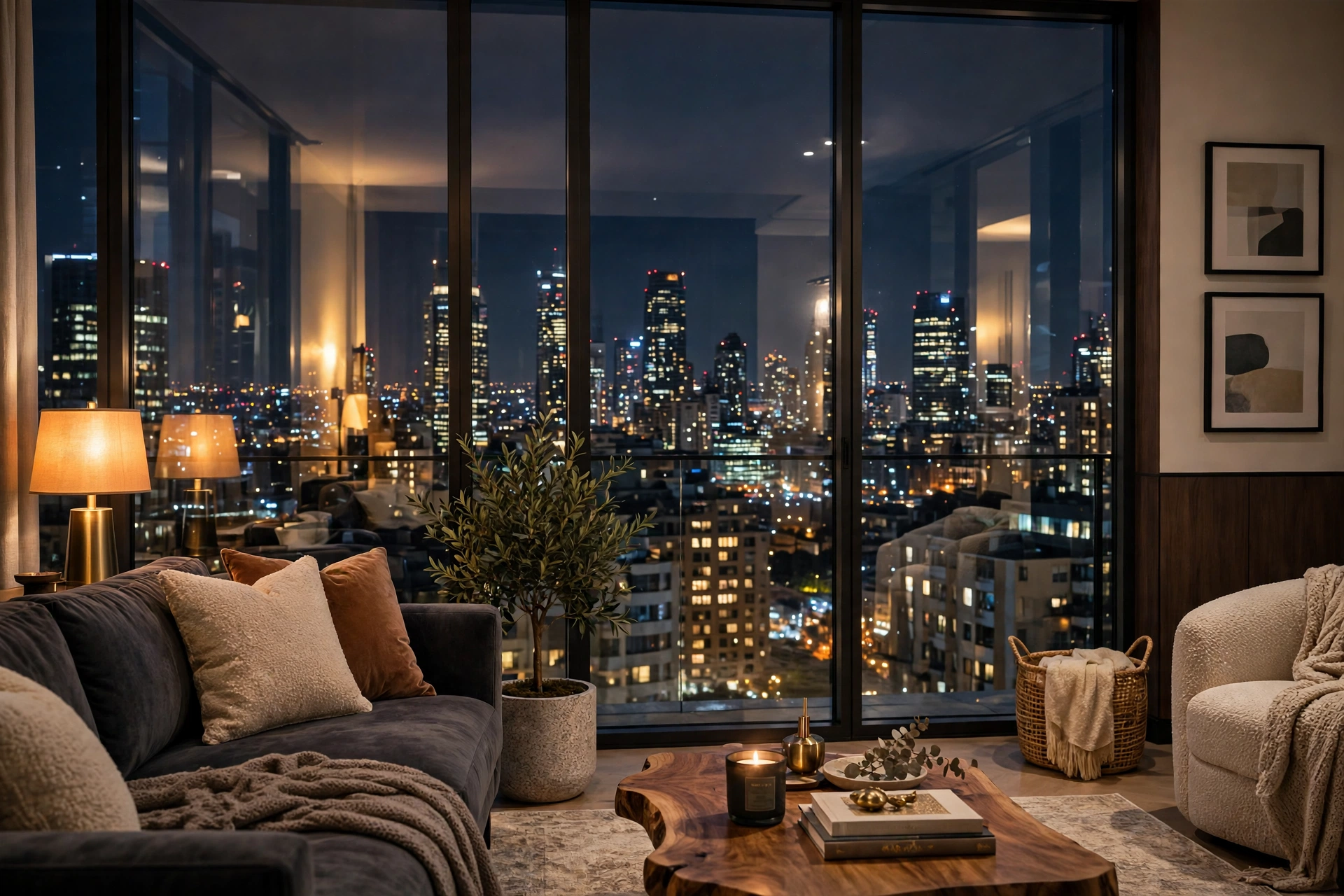
After dark, floor-to-ceiling windows reflect the room back at itself. Handled well, this doubles the sense of space and makes lamplight feel glamorous. Handled badly, a bright ceiling light turns the room into a fishbowl and erases the city beyond.
Use low, warm, dimmable light: table and floor lamps at seating height, picture lights, and candles or their rechargeable equivalents on the table. Keep overhead lights for tasks, then dim them right down. Outside the glass, the city provides the sparkle; inside, your lighting should be a soft glow that lets both layers show. If your building has a balcony or terrace, a single lit planter or lantern out there restores depth at night and reminds the eye that the view still exists.
Privacy at night follows from the same layers: sheers closed give a luminous screen, blackout layers give complete seclusion. Test your setup from the street or a neighboring building if you can — residents are often surprised by what lamplight reveals.
Practicalities Nobody Mentions in the Brochure
Window washing on high floors is a scheduled building service in many developments, but interior glass is yours, and large panes show streaks in raking light. A quality squeegee, a microfiber routine, and cleaning on a cloudy day (sun dries solution too fast) keep it manageable. Budget time for it in proportion to your glass — it is the penthouse equivalent of mowing a lawn.
Temperature varies near the glass: a chair right against a cold pane in winter or a hot one in summer will not be a favorite. The furniture island solves most of this; a slim console or a row of plants can act as a buffer where space is tight. Rugs also matter more here, warming floors and softening the echo that hard glass surfaces create. Add soft furnishings generously if the room sounds hollow — curtains, cushions, upholstered pieces, and books all absorb sound.
If you are costing out a move to a high-floor home or a furnishing refresh for one, a calm pass through the numbers helps — the financial calculators hub is useful for comparing purchase or rent, furnishing, and running costs before the view sweeps you away.
A Simple Formula to Copy
If you take one arrangement away, take this: a low sofa facing the view at an island’s center, two slim chairs angled in, a glass or stone coffee table, a large textured rug beneath, sheers ceiling-to-floor behind you at the glass, one tall plant in the corner where two window walls meet, and warm lamps at either end of the sofa. Dining table parallel to the glass with open-back chairs. Nothing tall against the windows, ever. That formula has furnished a thousand skyline rooms because it works with the architecture instead of against it.
For more top-floor and luxury living ideas, browse the Millionaire Lifestyle category — the penthouse guides in this series cover layouts, terraces, and small-space tricks that pair perfectly with great glass. Let the view be the drama. Your job is simply to frame it, soften it, and sit down to enjoy it.
