
Here is the secret nobody in the luxury property world minds you knowing: most of what makes a mansion look like a mansion is not the building. It is scale, symmetry, light, tidiness, and a handful of details repeated with confidence. A normal house already has walls, windows, and a roof. What it usually lacks is intention.
That means the mansion look is surprisingly borrowable. You will not turn a modest home into a country estate with paint and planting — and you do not need to. The goal is the feeling visitors get in the first ten seconds: composed, generous, and calm. These budget tricks are ordered roughly by impact per pound, dollar, or rupee spent, starting outside and working in.
1. Fix the First Ten Seconds: Front Approach
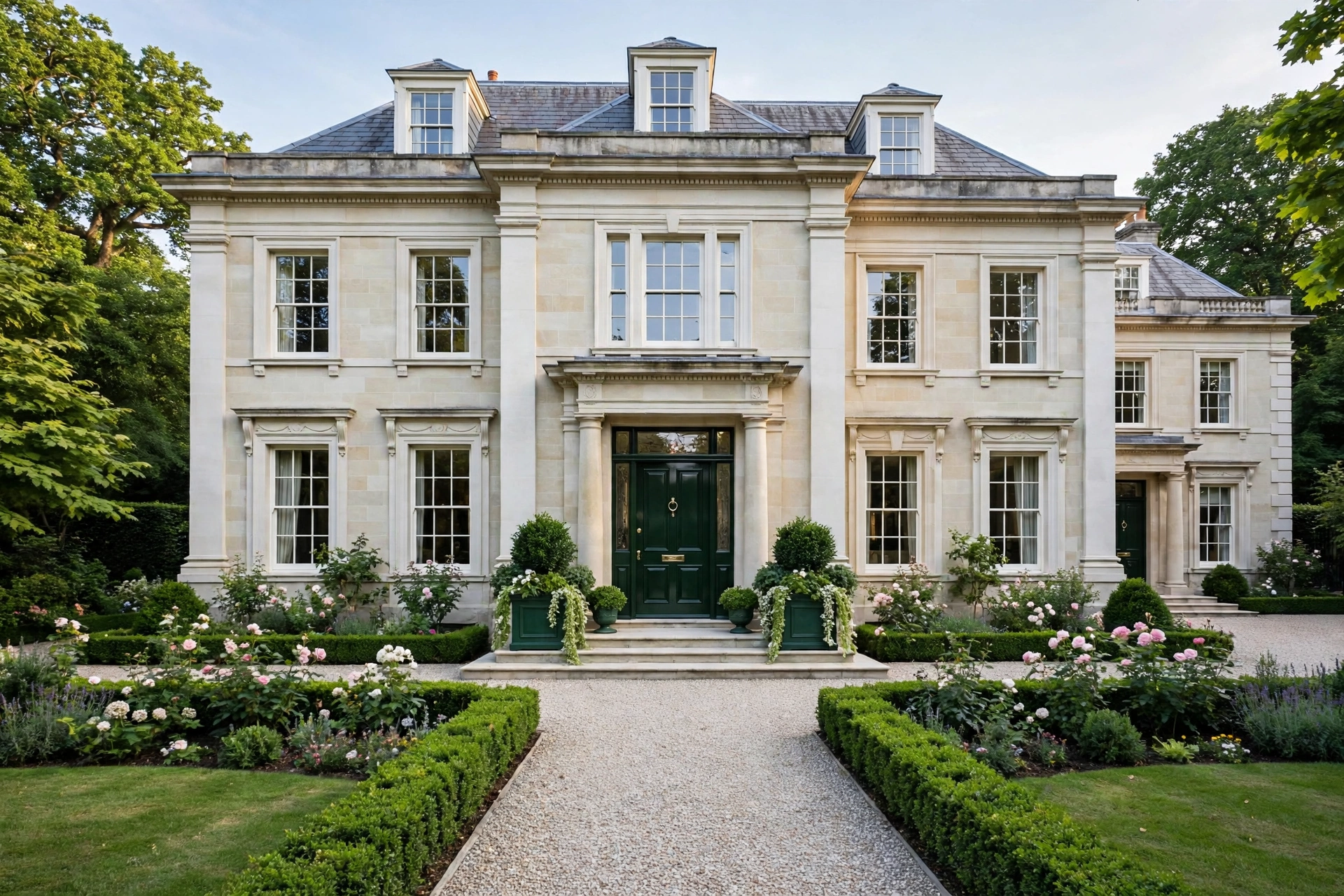
Stand across the street from your own house and look at it like a buyer. Mansions announce themselves with a clean approach: an edged path or drive, a defined boundary, and a front garden with structure rather than clutter.
Sweep, edge, and weed ruthlessly — free, and transformative. Add a pair of matching planters flanking the front door; symmetry is the cheapest luxury signal there is. If the budget stretches to one purchase, make it gravel or stone chippings over a tired drive or front garden area. Gravel reads expensive, sounds expensive underfoot, and covers a multitude of sins beneath a proper membrane.
2. Paint the Front Door — and Upgrade Its Hardware
A deep, glossy front door colour is the single best-value mansion trick in existence. Near-black, deep racing green, or rich navy, finished in satin or gloss, instantly suggests a heavier, more expensive door than the one you own. Paint the frame the same colour for a taller, grander effect.
Then replace the hardware. A solid centre knob or a substantial handle, a proper letter plate, and a clean modern-classic house number in brass or matte black cost little and are touched and seen every single day. If your door has a tired fanlight or side panel, privacy film with a fluted or frosted finish gives it the tailored look of bespoke glazing.
3. Unify the Windows
Mismatched windows are why many good houses look ordinary. Mansion facades use one window style, one colour, one rhythm. You can fake a surprising amount of that unity: repaint all exterior frames the same deep colour, add simple external shutters only if the architecture genuinely suits them, and keep window dressings inside consistent from the street — similar linings or blinds in every front window.
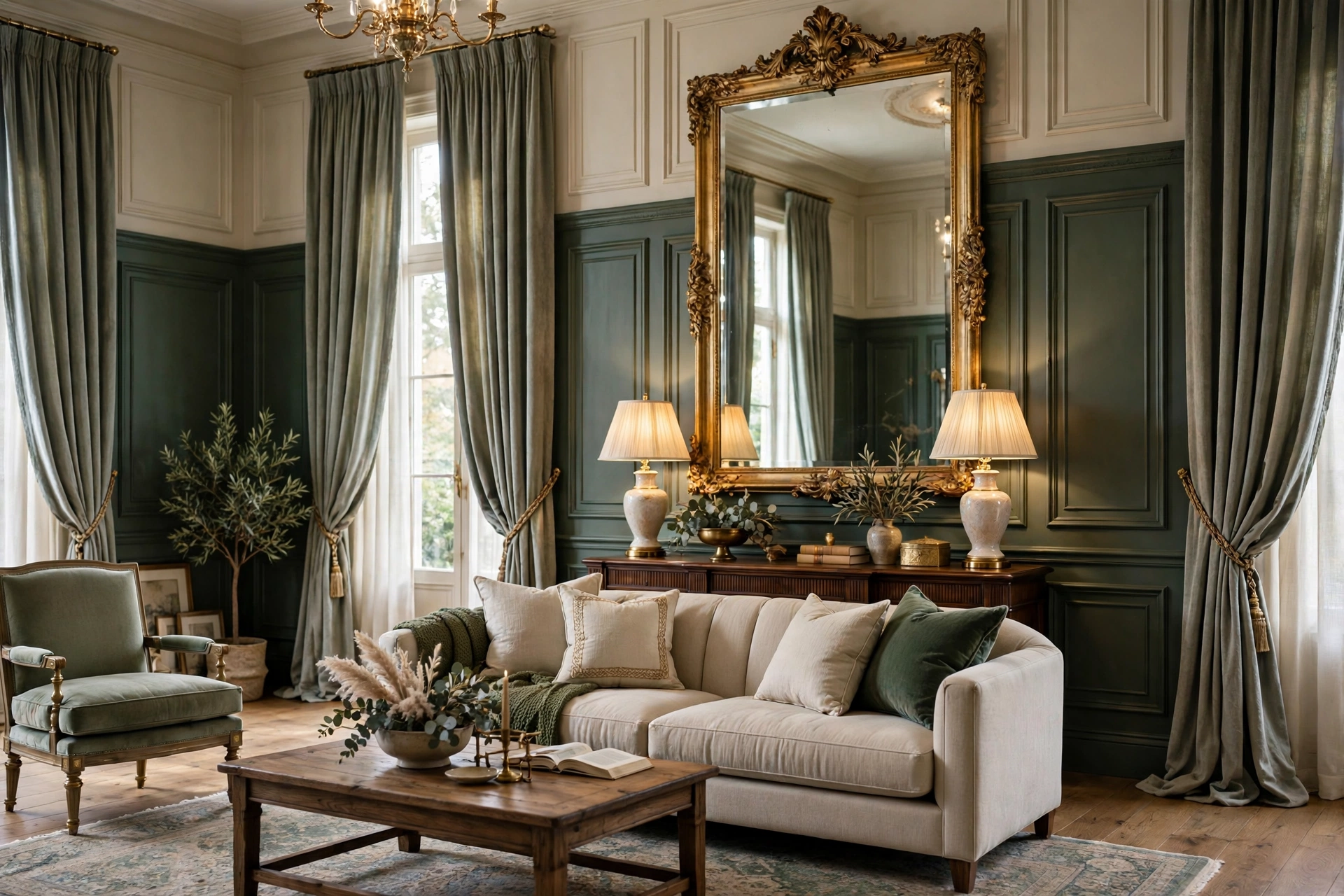
Inside, hang curtains high and wide. Mounting the rail close to the ceiling and well beyond the window frame makes windows look taller and rooms look grander. Floor-length curtains in a plain, heavy-looking fabric do more for the mansion feel than almost any furniture purchase.
4. Light It Like a Hotel
Hotels and mansions share a lighting rule: many soft sources, never one harsh one. Swap bright white bulbs for warm ones everywhere. Add lamps at different heights instead of relying on ceiling lights, and put the main rooms on dimmers if you can.
Outside, two wall lanterns flanking the front door and a few low solar or wired lights along the path create the evening glow that makes houses look expensive after dark. Inside, the classic budget formula is a pair of matching table lamps — symmetry again — on a console, sideboard, or bedside tables. Matching pairs read as “designed”; singles read as “collected by accident.”
5. Go Bigger With Fewer Pieces
Mansions feel spacious because their furniture is scaled up and their clutter is scaled down. The budget version: fewer, larger pieces. One oversized mirror instead of three small ones. One big rug that furniture actually sits on, instead of a small rug floating in the middle. One large piece of art — you can print high-resolution classic artwork, which is often free to download from museum collections, and frame it simply at scale — instead of a scattered gallery of small frames.
Edit surfaces hard. Clear counters, closed storage, and one styled tray or stack of books where ten objects used to sit. Luxury is mostly empty space, defended daily.
6. Steal the Hotel Bedroom and Bathroom Formula
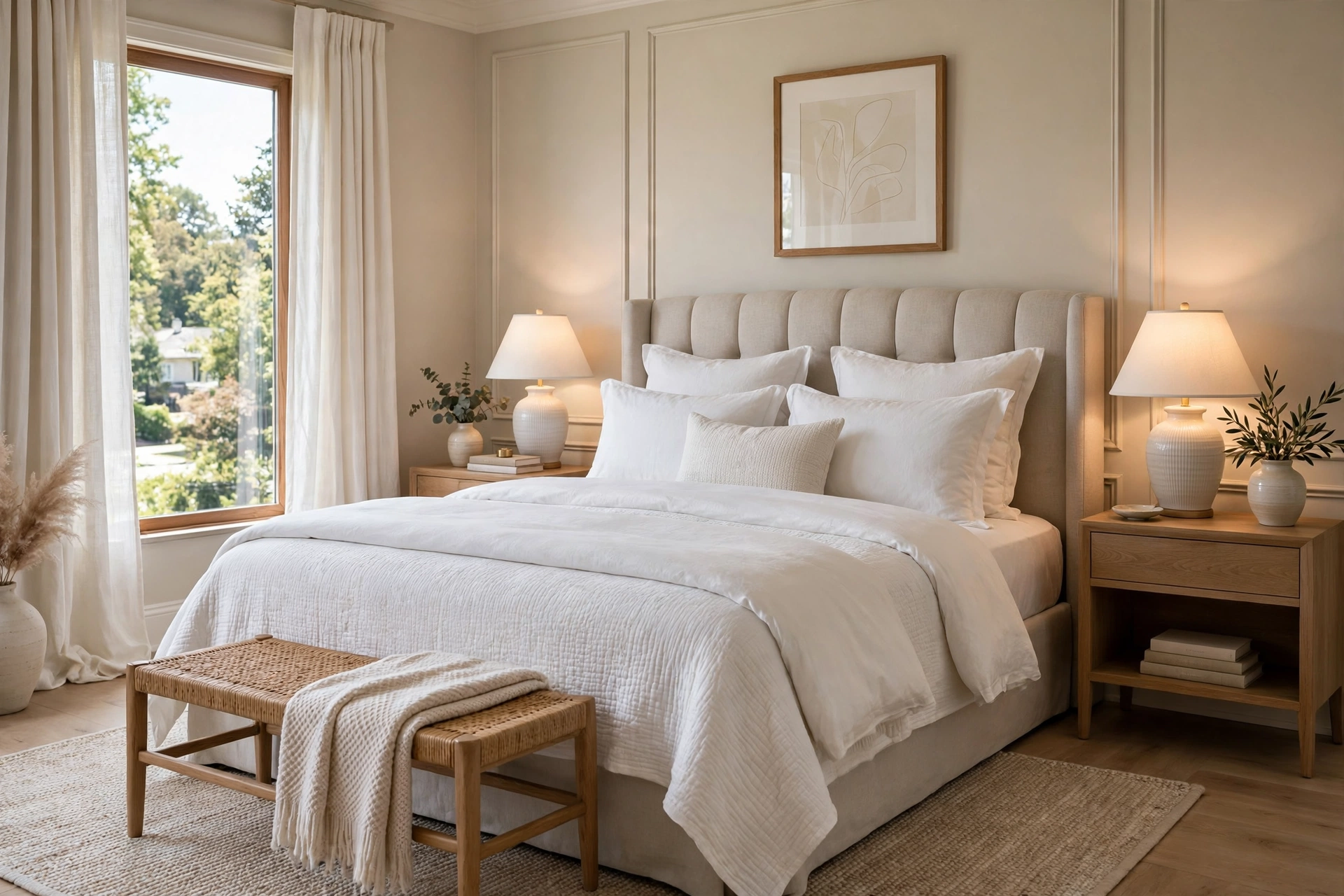
Five-star bedrooms rely on layers, not cost: white or pale bedding, a folded throw, cushions in pairs, and bedside lamps that match. You can buy the look inexpensively by keeping the palette to two or three colours and repeating them. A padded headboard — including a simple DIY panel version — adds the upholstered softness that reads as luxury in every property photo.
Bathrooms follow the same trick. Rolled white towels, a wooden stool or tray, decanted toiletries in matching bottles, and a plant that tolerates humidity. Remove the plastic bottles, the worn bath mat, and the clutter from every surface, and a basic bathroom photographs like a boutique one. It also feels better to use, which is rather the point.
7. Add Architectural Detail With Trim and Panelling
Mansions have walls with structure. Modern budget panelling — simple timber strips applied as rectangles, painted the same colour as the wall — adds that structure for the cost of wood, filler, and paint. It works best in hallways, living rooms, and behind beds, in one consistent style per room.
Coving or crown moulding where the wall meets the ceiling, deeper skirting boards, and picture rails all pull in the same direction: they make plain boxes feel built. Keep profiles simple and paint everything one colour, ideally a soft off-white or a muted tone-on-tone shade, which looks far more expensive than bright white contrast everywhere. If you are costing a room-by-room plan, our financial calculators are a handy way to keep the whole project honest before you start.
8. Create One “Wow” Room Feature
Every mansion tour has a moment: the double-height hall, the library wall, the stone fireplace. A normal house needs just one. A floor-to-ceiling bookcase wall (flat-pack shelves, trimmed and painted to look built-in) is the classic. A statement fireplace surround, a bar cabinet corner styled like a hotel, or a dining room with a large pendant light hung low over the table all work.
Choose the room guests see most, invest your one feature there, and keep the rest calm. Concentration beats spreading a thin layer of “luxury” across every room, which ends up looking like none.
9. Landscaping Structure on a Budget
You do not need a gardener to borrow the mansion garden formula: evergreen structure, clean edges, limited colours. A few clipped evergreen shrubs in matching pots, a hedge or pleached screen where privacy is thin, and borders mulched in one dark, even layer look designed rather than accumulated.
Lawn edges matter more than lawn size. A crisp metal or stone edge between lawn, path, and border is inexpensive and makes the whole garden look maintained by professionals. Add one specimen — a small ornamental tree in the front garden — and light it from below at night for the full estate effect.
10. Smell, Sound, and the Invisible Layer
Mansion feel is not only visual. Houses at the top end smell faintly of one thing — cedar, fig, amber — not of five competing air fresheners. Choose one home scent and use it consistently. Keep a calm background: soft music in living spaces beats television noise, and a heavy front door that closes with a solid, quiet thud is a detail guests register without knowing why.
Small maintenance is part of this layer. Scuffed paint, a dripping tap, a squeaking hinge — each one quietly tells the brain “ordinary.” A weekend spent on touch-ups and fixes does more for perceived luxury than most purchases.
What to Skip
Save your money by avoiding the classic fake-luxury traps: shiny gold accents in quantity, imitation marble stickers on every surface, crystal-style plastic chandeliers, and oversized logos or novelty features. Each one tries to look expensive and achieves the opposite. Real wood, real cotton, real plants, plain finishes, and good light beat imitation luxury every time.
Work through the list in order — approach, door, windows, light, scale, one feature — and your house will not literally become a mansion. But it will gain the thing mansions actually have and most houses lack: the sense that every detail was decided on purpose. For more transformations in the same spirit, explore the rest of our Millionaire Lifestyle guides.
