
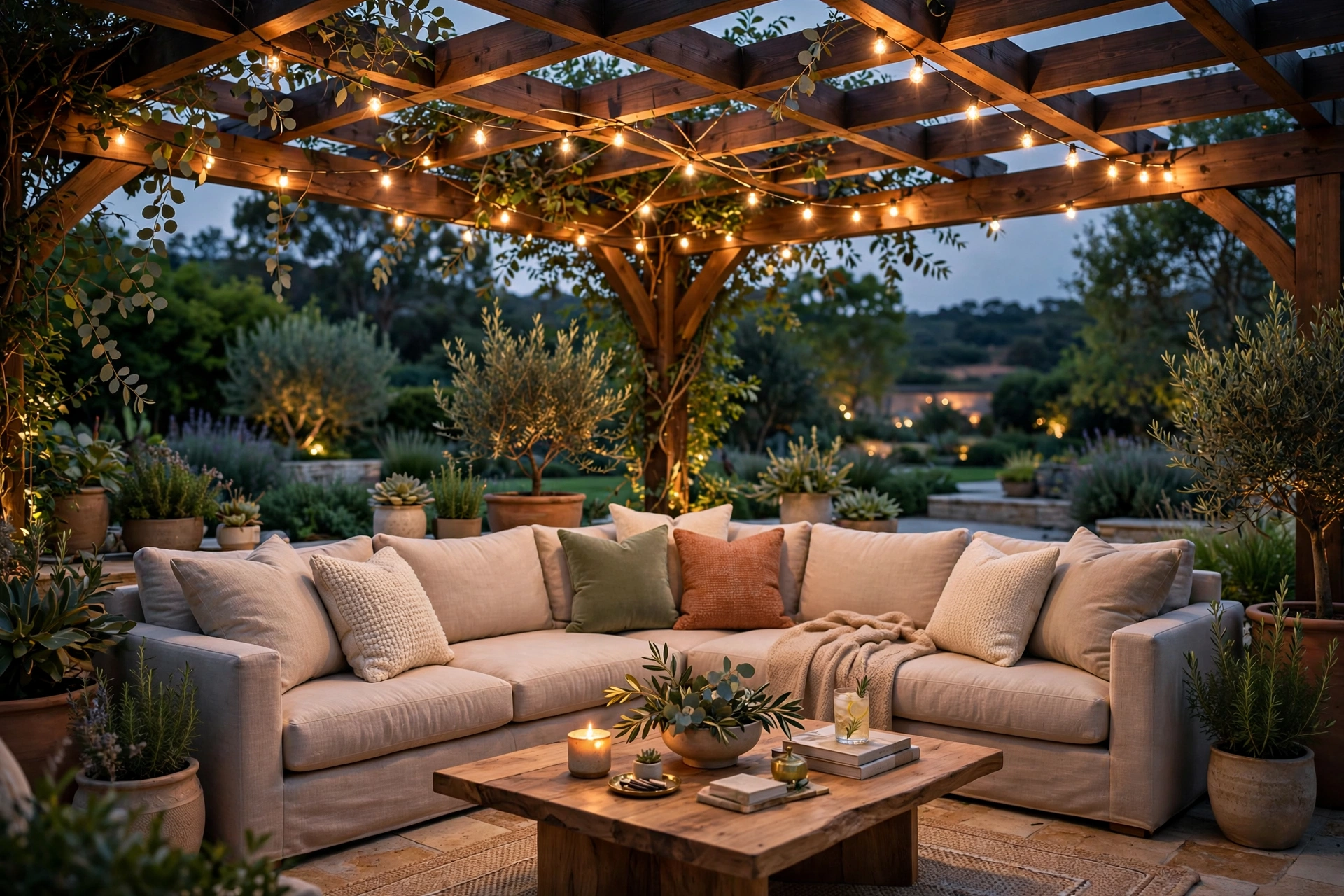
The most enjoyed luxury homes share a secret: the best room is not inside at all. An outdoor living room — a proper lounge under cover, with sofas you can sink into, light you can dim, and heat for cool evenings — quietly becomes where mornings start and evenings end. It is not a patio with a few chairs scattered on it. It is a room that happens to have the sky for a ceiling.
The good news is that the feeling does not depend on a huge budget or a huge garden. It depends on the same things that make an indoor lounge work: a defined boundary, comfortable seating arranged for conversation, layered light, and protection from sun, wind, and rain so the room is usable for more of the year. Here is how to build one, step by step, whether you are working with a terrace, a pergola, or one corner of a garden.
Define the Room Before You Buy Anything
Indoor rooms have walls. Outdoor rooms need substitutes, or the furniture just floats and the space never feels settled. Designers define an outdoor lounge in four ways, and the best spaces use at least two.
First, a floor. An outdoor rug, decking, or a change in paving instantly marks the lounge zone. Second, a ceiling — a pergola, a deep roof overhang, a retractable canopy, or even a large shade sail gives the sense of enclosure and, crucially, shade. Third, a backdrop: a hedge, a slatted screen, a stone wall, or tall planters behind the sofa anchor the seating the way a wall does indoors. Fourth, a focal point, which we will come to next.
Measure like it is indoors
Treat the space with indoor discipline. A comfortable lounge needs room for a sofa, two chairs, a coffee table, and walking space around them. As an illustrative example, a zone roughly four by five meters can hold a three-seat sofa, two armchairs, and a low table without feeling squeezed — smaller terraces can scale down to a loveseat and one chair and still feel like a room if the boundaries are clear. Tape the layout on the ground before ordering anything; your feet will tell you more than a catalog photo.
Arrange Seating for Conversation, Not for the View Alone
The classic mistake is lining all the seating along the house wall, facing out like a cinema. The view matters, but people sit longest where they can talk. An L-shaped arrangement or a sofa facing two chairs creates a conversation circle, with the view enjoyed over shoulders and during pauses — which is how we actually experience it.
Choose furniture you would accept indoors
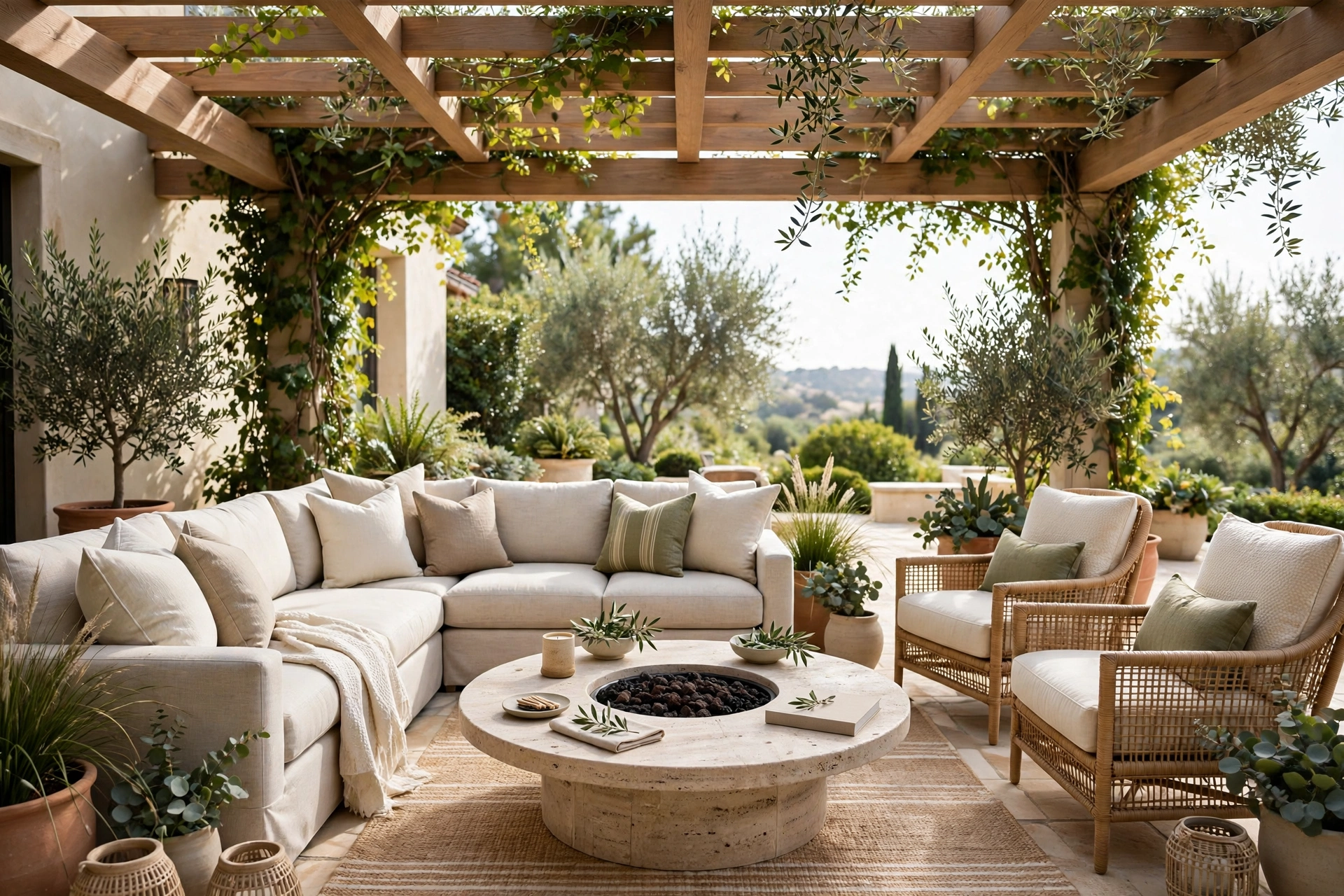
Luxury outdoor furniture has closed the gap with indoor pieces: deep cushions, proper springs in some ranges, and fabrics that shrug off sun and rain. Prioritize seat depth and cushion quality over matching sets. A single excellent sofa with two mismatched but comfortable chairs looks more personal and high-end than a uniform set of thin-cushioned pieces.
Materials that age gracefully include teak, powder-coated aluminum, and woven resin that mimics natural rattan without its fragility. Cushions in solution-dyed acrylic resist fading and can stay out through a shower, though a slim storage box nearby for the wettest months will extend their life for years.
The coffee table does quiet work
Pick a table large enough for drinks, a book, and feet — because feet will go up. Stone, concrete, and teak tops handle heat and rings without fuss. Add one or two small side tables so nobody has to balance a glass on an armrest; these small conveniences are what make a space feel considered.
Give the Room a Focal Point
Every memorable lounge has a center of gravity. Outdoors, the strongest choice is fire: a fire pit table, a built-in fireplace on a covered terrace, or a simple bowl. Fire extends the season, gives eyes somewhere to rest, and gathers people the way a hearth always has.
If fire is not possible — some buildings and dry climates restrict it — alternatives include a water feature with a soft sound that masks traffic, a large sculptural planter, or an outdoor rug and table grouping under a statement pendant light on a covered porch. What matters is that the seating turns toward something shared.
Shade, Shelter, and Heat: The Comfort Triangle
An outdoor living room that is only comfortable at 6 p.m. in June will be admired and rarely used. Plan for three conditions.
Shade. A pergola with a retractable canopy is the flexible favorite: open sky on starry nights, cover at midday. Climbing plants on a pergola look romantic but take seasons to establish and drop leaves into drinks; a clean canopy plus potted greenery is the lower-effort route to a similar feeling. Orient shade for the afternoon sun, which is when most lounges get used.
Shelter. Outdoor curtains or glass sliding panels on the windward side of a covered terrace transform usability in breezy or drizzly weather. Even a simple slatted screen breaks wind enough to keep cushions and conversations comfortable.
Heat. One good heat source beats three weak ones. Options include a fire pit, a ceiling-mounted electric heater under a roof, or a standing gas heater. Electric heaters under a pergola roof are discreet and instant; fire gives atmosphere as well as warmth. Many high-end spaces use both — fire for the mood, a quiet heater for real chill.
When you are weighing a covered structure or heating against other home projects, it helps to run the numbers calmly first — our financial calculators hub is a useful place to compare one-off costs with ongoing running costs before you order.
Lighting in Layers, Just Like Indoors
Outdoor lighting follows the same three layers as a living room. Ambient light: a soft wash from a pendant or fan light under a roof, or string lights used sparingly — one or two strands overhead, warm white, on a dimmer if possible. Task light: a floor lamp rated for outdoor use beside a reading chair, or a small table lamp on a side table. Accent light: uplights in planters, a lit tree beyond the terrace, or candles and lanterns on the table.
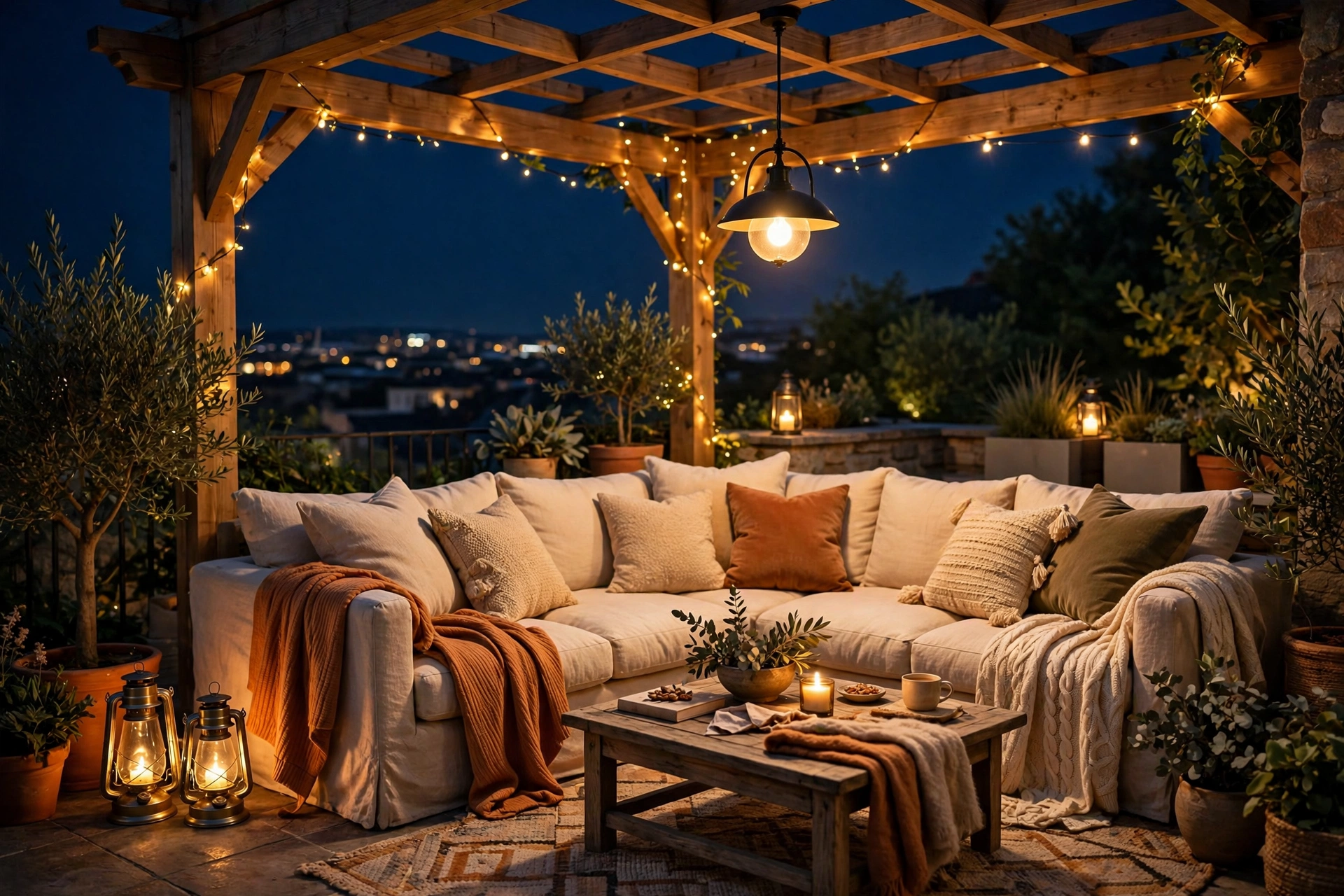
Warm color temperature is the unifying trick. Mixed cool-white bulbs make even expensive furniture look like a showroom car park. Keep everything warm, keep it dimmable where you can, and let the fire or candles provide the flicker that no bulb quite matches. Solar path lights are fine for a garden edge, but for the lounge itself, wired or rechargeable lamps give steadier, warmer light.
Textiles, Greenery, and the Finishing Layer
This is where an outdoor lounge stops looking like furniture on a slab and starts looking like a room in photographs. Add an outdoor rug with a subtle pattern to hide the inevitable dust. Layer two or three cushions per seat in a restrained palette — one solid, one stripe, one texture is a reliable formula. Keep a basket of throws by the door for cool evenings; wool-look acrylic throws wash easily and live outdoors happily.
Greenery should be at two heights: tall plants or small trees in large pots to soften corners and give privacy, and low arrangements on tables — a tray with a small potted herb, a lantern, and a stack of coasters makes a table feel styled rather than bare. Choose plants for your actual light and watering habits. A row of healthy, simple plants in beautiful pots always beats exotic specimens struggling to survive.
Privacy deserves a final mention. A lounge you feel watched in will not be used. Screens, hedges, tall grasses in planters, or a well-placed pergola post with a climbing plant can block a neighbor’s window sightline without building a fortress.
Keep It Easy to Live With
The richest-feeling outdoor rooms share one trait: they ask very little of you. Covers that slip on in a minute, cushions that can stay out, a broom and storage box within reach, and surfaces that forgive a spilled drink. Before buying, ask of every piece: where does this live in winter, and how do I clean it? If the answer is complicated, choose the simpler piece — you will thank yourself every season.
Start with boundaries and the sofa, add fire and light, then layer textiles over a few weekends as you see how you actually use the space. For more ideas that pair with this project — pools, gardens, and evening lighting — explore the Millionaire Lifestyle collection. Build the room slowly, use it constantly, and it will earn its title as the second lounge: the one everyone chooses first.
