
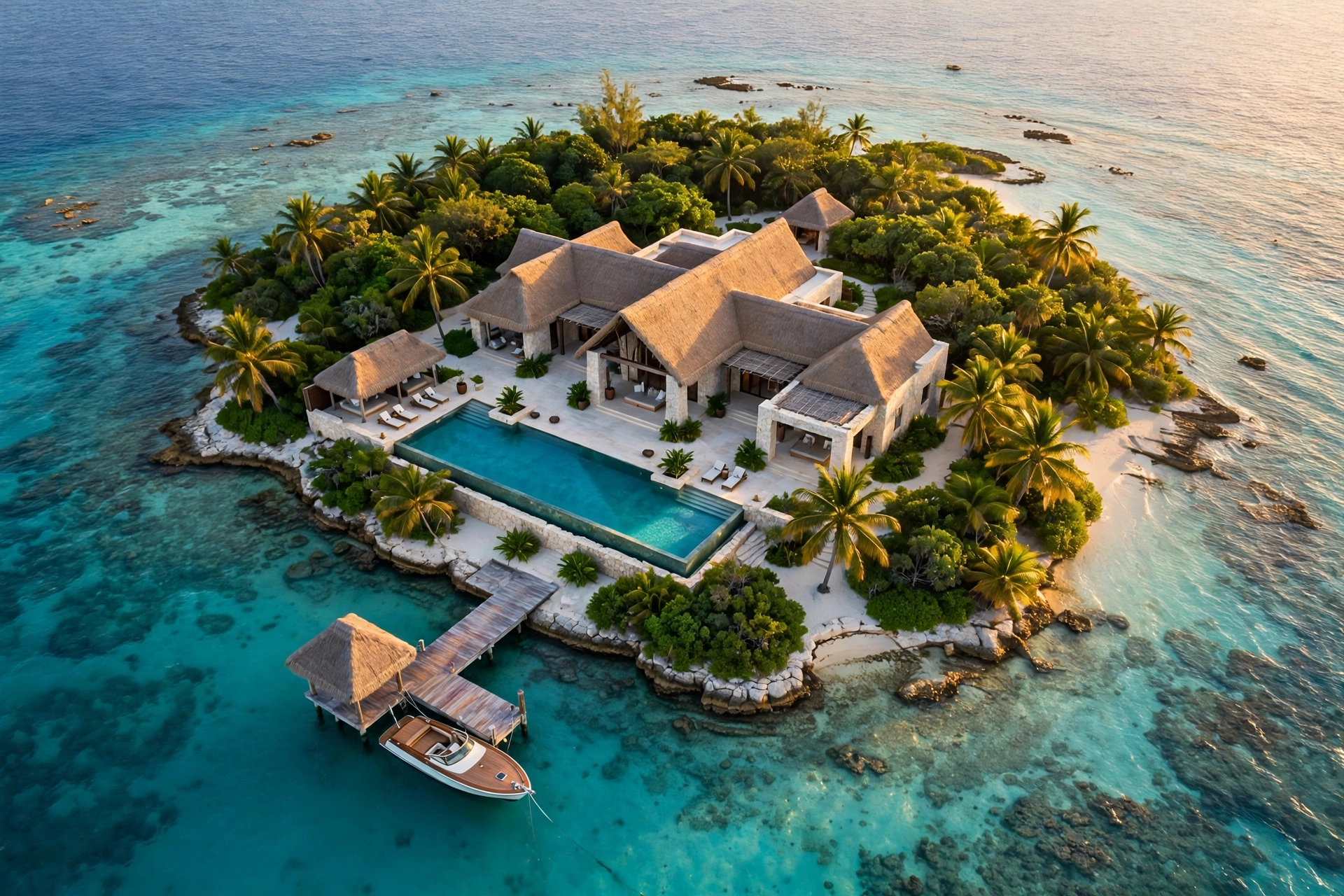
There is ordinary privacy, and then there is water on every side. A private island home removes the street, the neighbours, the passing cars and the casual onlookers in one move. What remains is a house designed around arrival by boat or helicopter, days shaped by tides and light, and a level of seclusion that no gated community can copy. The appeal is not just size. It is control — over who arrives, what you see, and how quiet your mornings are.
That seclusion, however, is not simply bought with a beautiful house. It is built, staffed, powered and maintained as a small, self-contained world. If you are dreaming about this tier of living, or designing a coastal home that borrows its best ideas, it helps to understand what actually sits behind the postcard view.
What Seclusion Really Means on a Private Island
No Road In, On Purpose
The defining feature is access. Most private island homes are reached by private dock, tender boat or helipad. Guests do not wander in. Deliveries are planned. That controlled arrival creates the calm owners pay for, but it also shapes everything else: furniture is chosen for durability in transit, building materials arrive by barge, and spare parts for generators, pumps and water systems are kept on site because a quick trip to a hardware store does not exist.
Good island houses embrace that reality instead of fighting it. Wide covered walkways connect buildings so rain does not cancel dinner. Storage is generous and hidden. Pantries, cold rooms and laundry spaces are larger than in a mainland house of the same size, because the house has to run smoothly between supply runs.
Privacy Planting, Not Just Fences
On an island, privacy comes from landscape. Mature palms, dense native planting and carefully placed guest pavilions mean you can host friends without seeing every part of their stay, and they can enjoy the island without feeling watched. Main houses are usually positioned for the best sunrise or sunset view, with guest houses tucked into separate coves or garden pockets.
That separation is a luxury in itself. It lets a property feel like a small private resort rather than one large house with too many bedrooms under one roof.
The Layout: A Village, Not a Single Box
Most high-end island properties in illustrative listings at this level — think of examples in the $5 million-plus range as a general tier, not a price for any one specific island — are compounds. There is a main residence, two to four guest pavilions, a staff house, and shared spaces that sit between them: a pool terrace, a beach pavilion, an outdoor dining sala and often a sunset deck on the opposite side of the island.
The Main House
The main house is rarely the largest building by drama alone. It is the most considered. Expect an open great room that frames water in two directions, a primary suite that can be closed off completely for true rest, and shaded terraces deep enough for sofas, not just a couple of chairs. Ceilings are high to release hot air, and cross-ventilation matters as much as air conditioning.
Materials lean natural and salt-tolerant: stone that does not mind bare feet, hardwoods rated for marine air, lime plaster, and metal fittings chosen because they will not corrode in a season. Shiny mainland luxury finishes often fail here. Island luxury looks softer, but it is engineered harder.
Guest Pavilions That Feel Private
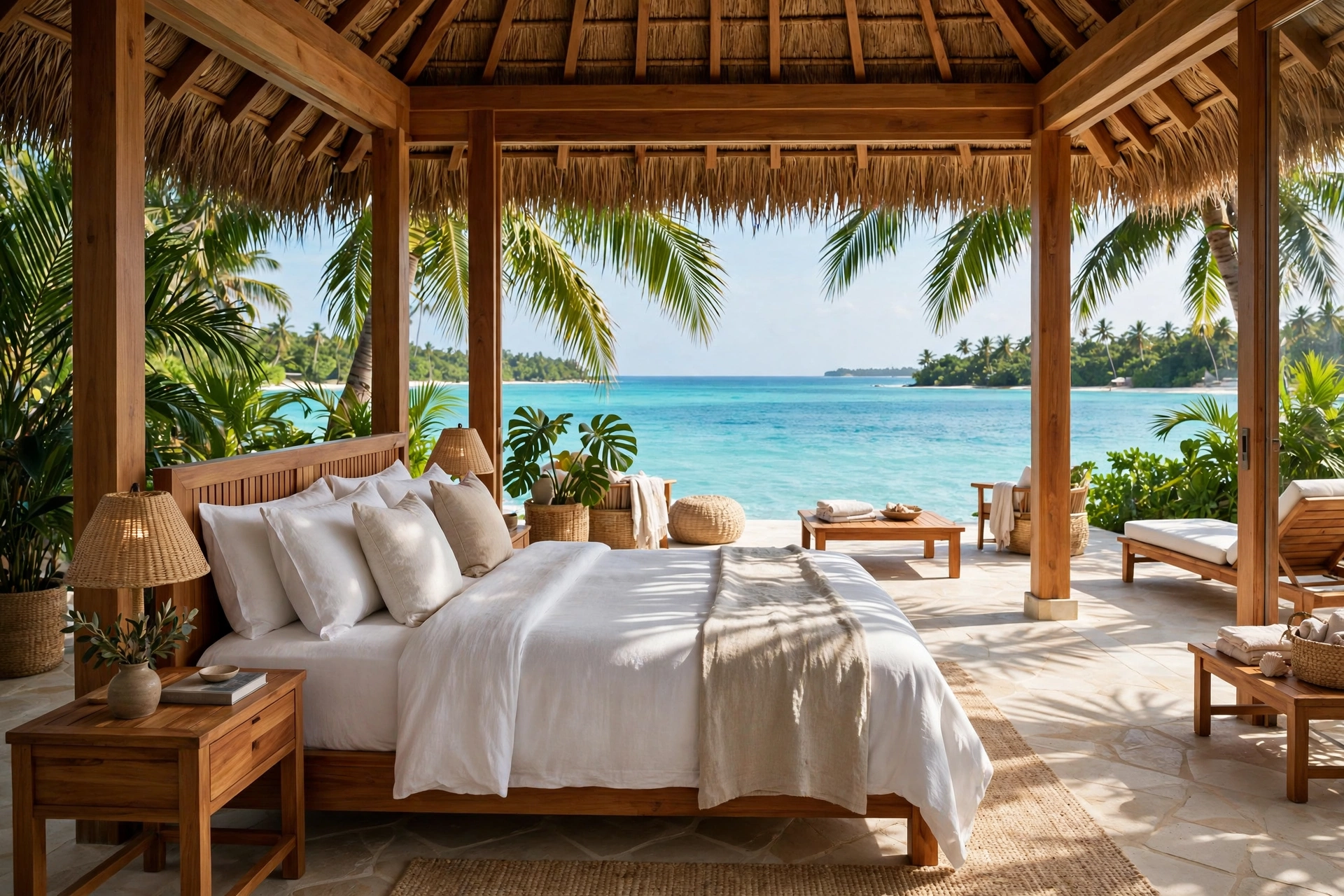
A well-designed guest pavilion has its own bathroom, a small sitting corner, a coffee or cold-drink station, and a terrace that does not face the main house. Guests can wake, swim and have a slow morning without coordinating with anyone. That independence is what makes hosting feel effortless rather than performative.
Staff Quarters and the Invisible Work
Seclusion only feels effortless when someone is quietly making it work. At this level, staff accommodation is part of the plan from the start — not an afterthought room by the generator. A housekeeper, caretaker, boat captain or chef may live on site full or part time. Their quarters, workshop and utility yard are screened by planting but kept close enough for quick response when a pump alarm sounds at 2 a.m.
If you are borrowing ideas for a mainland home, borrow this one: hide the working parts beautifully. A screened utility court, a proper laundry and a lockable storage barn make the visible parts of a home feel calm.
Power, Water and Connectivity: The Real Luxury Systems
On a private island, the most important luxuries are invisible.
Power usually comes from a hybrid system: solar arrays, battery storage and a backup generator. The house should run fridges, water pumps and communications even if one system is down for maintenance.
Water is either barged in, collected from roofs into large cisterns, produced by desalination, or a combination of all three. Showers, pools and gardens depend on careful planning, which is why island landscaping favours native, drought- and salt-tolerant planting over thirsty lawns.
Connectivity has transformed island living. Satellite internet now makes remote work, streaming and smart-home controls realistic in places that once had a single unreliable phone line. Owners still design an offline mode — printed instructions, manual overrides for gates and pumps, and lighting that works without an app — because technology at sea needs a backup.
Thinking about the running side early matters for any luxury purchase. The free tools on our financial calculators hub are a useful starting point for modelling ongoing costs alongside a purchase price, whether the home is on an island or on a quiet mainland street.
Design Details That Make Island Life Feel Five-Star
Arrival as a Moment
The dock is the front door. The best properties make it an experience: a shaded waiting pavilion, an outdoor shower to rinse off after the boat ride, a clear path lit low at night, and a first view that opens to water through the house, not to a blank wall. Golf carts or soft-path buggies often replace cars entirely.
Outdoor Rooms for Every Hour
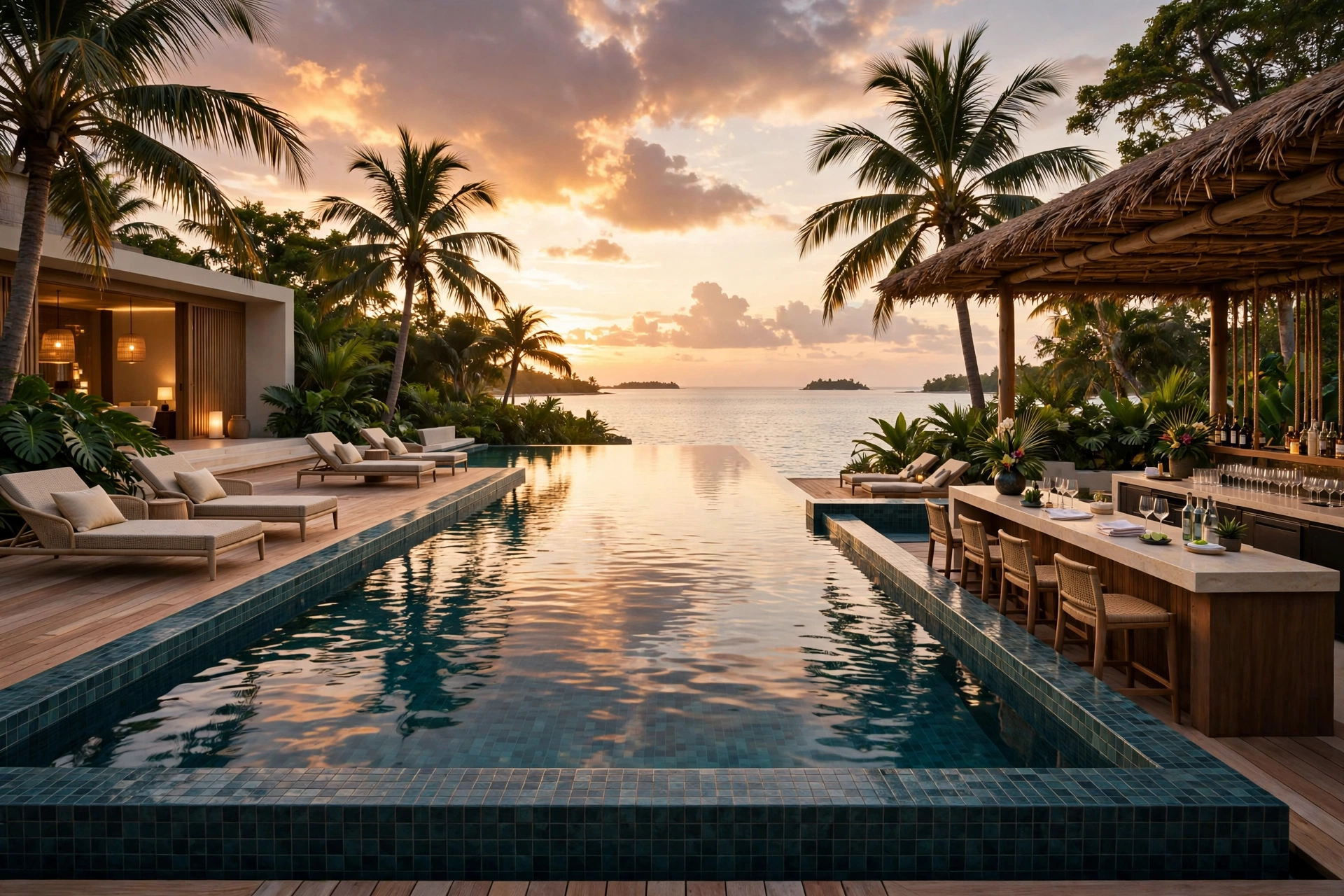
Because the climate invites living outside, one terrace is never enough. Look for a bright breakfast terrace facing morning light, a deep shaded lounge for midday, a pool deck that catches afternoon sun, and a west-facing sunset bar. Each space has a purpose, so the property feels rich in experiences without needing excessive indoor square footage.
A Pool That Belongs to the Place
Island pools tend to be long, low and horizon-edged, tiled in deep blue-green tones that echo the sea rather than bright resort blue. Some properties add a second, smaller plunge pool by the primary suite. Saltwater systems are popular for a softer feel and easier care in remote settings.
What to Check Before You Fall in Love With One
Aspirational browsing is fun, but this tier rewards careful questions. Access in bad weather, hurricane or storm history, insurance availability, fresh-water reliability, waste removal, medical evacuation options and local rules on ownership, leasing and building all matter more than the thread count of the sheets. So does honest staffing: who will live there when you do not, and how will the house be opened, closed and checked each week?
Also consider how you will actually use it. A property that sleeps fourteen is wonderful for two big gatherings a year and wasteful the rest of the time if the systems must run constantly to prevent damp and decay. Tropical houses need to breathe and be lived in, or be actively managed in absence. The most satisfied owners choose a size their household and team can genuinely sustain.
For more homes that trade street noise for space, light and privacy, browse the full Millionaire Lifestyle collection — villas, beach houses and penthouses included.
Borrowing the Island Feeling Without Buying an Island
You do not need surrounding water to steal the best ideas. Create an arrival moment with a gated garden court. Split a guest suite from the main house, even by a covered walkway, to give everyone breathing room. Plant for privacy in layers instead of building a higher fence. Add an outdoor room for the hour you actually have free — morning coffee or sunset — rather than a generic patio. Choose marine-grade, weather-honest materials outdoors. And design storage for the unglamorous things, so the beautiful things stay uncluttered.
Private island homes endure in the imagination because they promise a simpler rhythm inside extraordinary settings. At their best, they deliver exactly that: fewer decisions, fewer interruptions, and rooms that exist to frame the sea, the sky and the people you invited across the water to share them.
