
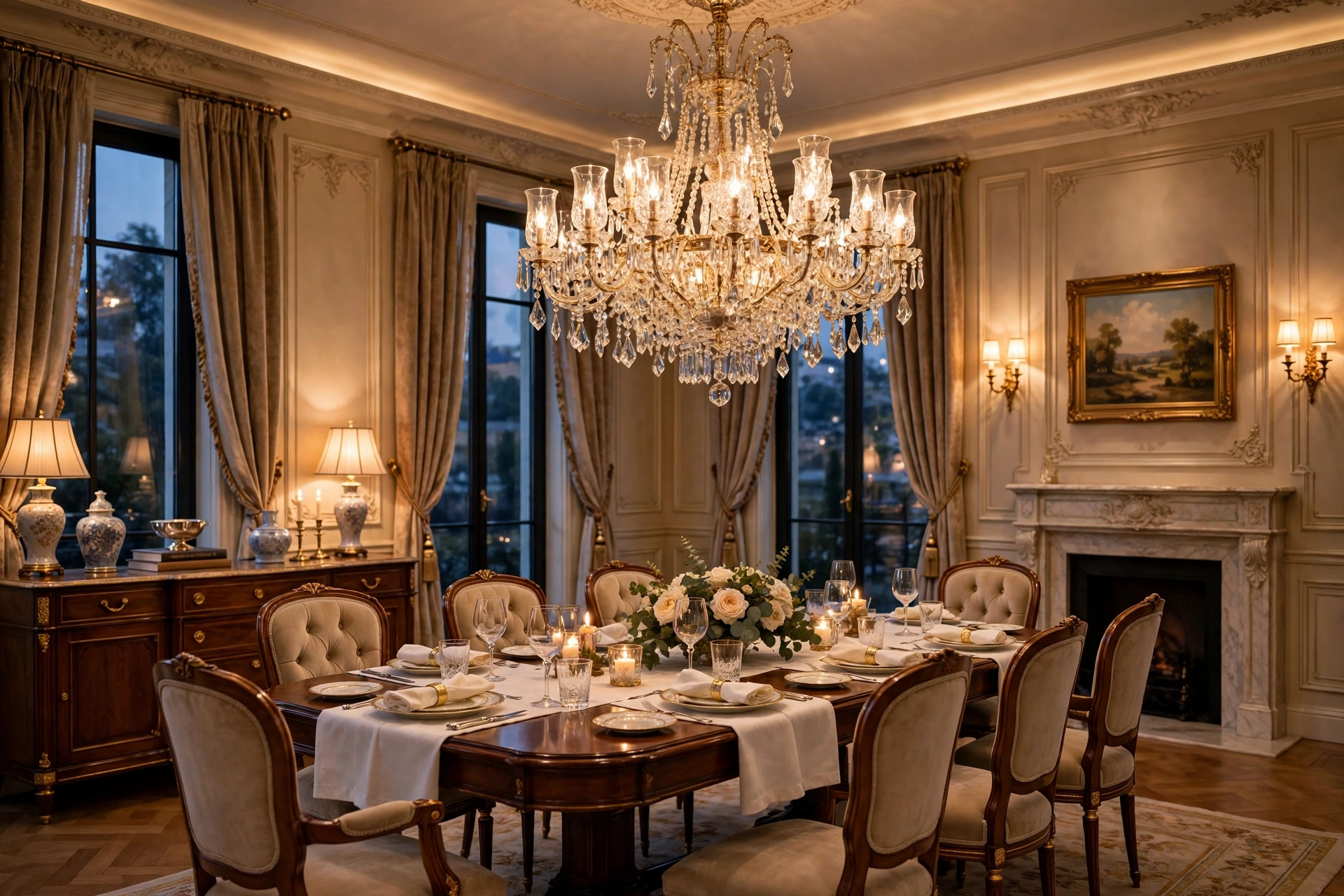
No single purchase changes a room faster than the light hanging in the middle of it. A chandelier is architecture, jewellery and mood in one object: it sets the ceiling height your eye believes, decides whether faces look warm or tired, and signals the room’s ambitions before a single piece of furniture registers. That is why designers often choose the statement light first and build the room beneath it.
Yet statement lighting is also where expensive mistakes happen — fixtures too small, hung too high, glaring too bright, or fighting every other element in the room. This guide covers how to choose, size, place and live with a chandelier that genuinely transforms the space.
Why One Big Light Works So Hard
A room without a focal point makes the eye wander and settle on clutter. A chandelier gives the eye a home. It also creates a centre of gravity for furniture: dining tables align under it, seating islands gather beneath it, and entry halls gain a destination. In open-plan homes, a statement fixture can define the dining or lounge zone more clearly than a rug.
Light itself is the second job. A multi-arm or multi-globe fixture spreads light across many points, softening shadows and flattering skin in a way a single downlight never can. Add a dimmer and the same fixture handles bright family breakfasts and low, golden evenings.
Choosing a Style That Suits the Room
Classic Crystal and Glass
Tiered crystal, glass droplets and candle-style arms bring formality and sparkle. They suit dining rooms, entry halls and traditional living rooms, and they earn their keep after dark, scattering light across ceilings. Modern versions with cleaner lines and smoked or fluted glass keep the glamour without the fussiness.
Sculptural and Modern
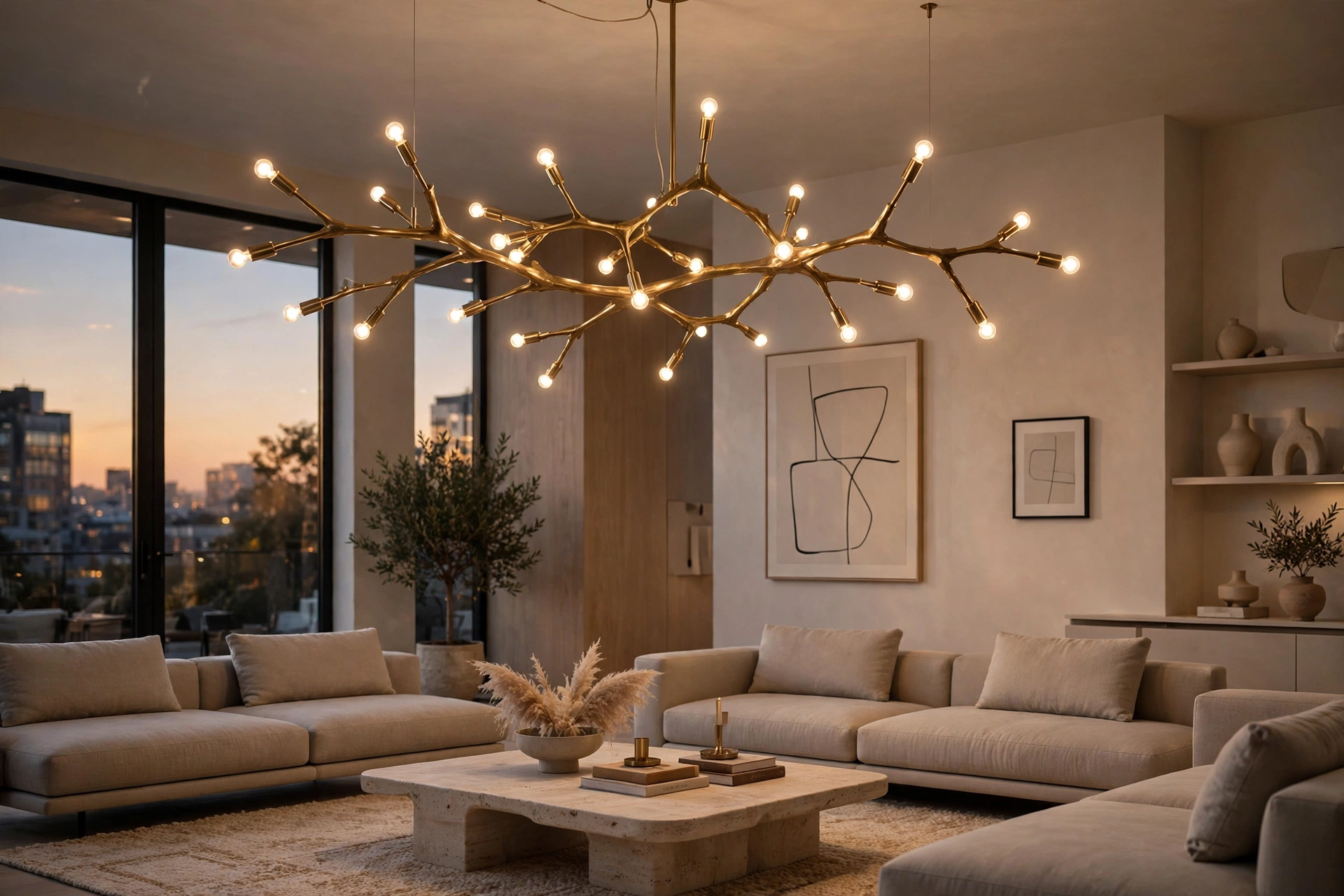
Branching brass arms, orbiting rings, cascading rods and organic blown-glass forms act as ceiling sculpture. These suit contemporary rooms where art is minimal and furniture is low — the fixture becomes the artwork. Choose one sculptural gesture and let it be alone; two competing sculptures cancel each other out.
Natural and Relaxed
Rattan, woven fibre, beaded and plaster fixtures bring warmth to coastal, island and quiet-luxury rooms. They diffuse light softly and pair with linen, timber and stone. Scale compensates for lightness: a large woven pendant over a dining table can be every bit as commanding as crystal.
Industrial and Architectural
Blackened steel, exposed globes and linear frames suit lofts, kitchens and modern extensions. Over a long table or island, a linear statement light often works better than a round chandelier, echoing the shape below it.
The Scale Rules Designers Actually Use
Undersizing is the most common error. A fixture that looks generous in a showroom shrinks against a real ceiling. Two simple guides help. For a room, add the length and width in feet; that number, in inches, is a sensible starting diameter — a 14-by-18-foot room suggests roughly a 32-inch fixture. For over a table, aim for a fixture between one-half and two-thirds the table’s width, centred precisely.
Height matters just as much. Over a dining table, the bottom of the fixture should sit about 30 to 36 inches above the tabletop — low enough to feel intimate, high enough to see faces across it. In a living room or hall where people walk beneath, keep at least seven feet of clearance, and in a double-height space, hang the fixture so it lives in the room’s volume, not lost against the ceiling. Long drops and multi-tier designs exist precisely for tall spaces.
When in doubt, tape the dimensions on the ceiling or hang a cardboard mock-up. Ten minutes of theatre prevents years of mild disappointment.
Bulbs, Colour and Dimming: The Invisible Half
The fixture is the body; the bulbs are the voice. Choose warm light — around 2700K for living and dining spaces — for the golden tone associated with luxury interiors. Check that bulbs are dimmable and pair them with a compatible dimmer; flicker at low levels ruins more chandeliers than bad taste ever has.
Consider brightness honestly. A statement fixture is rarely a room’s only light source, nor should it be. Pair it with wall lights, table lamps or discreet downlights so the chandelier can run low and atmospheric while other sources do the work. That layering is what makes hotel and restaurant lighting feel rich: the hero light glows, it does not glare.
Crystal and glass need the right bulb shape and clarity to sparkle; frosted bulbs mute them. Sculptural metal fixtures often look best with visible filament-style LEDs chosen as part of the design.
Placement Beyond the Dining Table
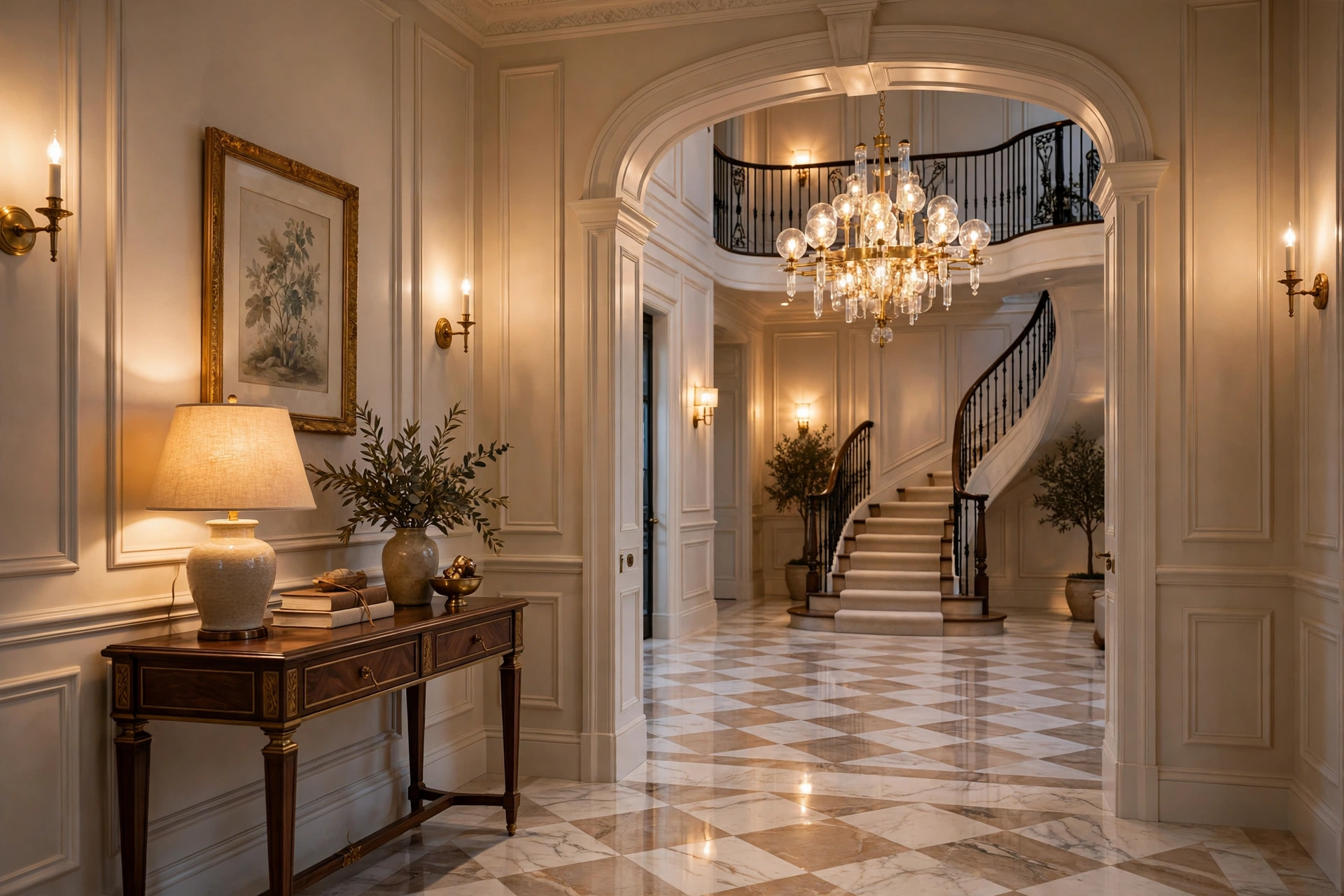
Bedrooms take chandeliers beautifully — a soft, low-glare fixture over the centre of the room or offset over a seating corner adds suite-like calm, provided it is on a dimmer and clear of ceiling-fan territory. Bathrooms in larger homes use small chandeliers over a freestanding tub, using fittings rated for damp zones and installed by an electrician who knows local code. Entry halls benefit most of all: a statement light visible through the front door or from the stairs sets the tone for the entire house.
In kitchens, statement pendants in a row of two or three over an island give rhythm. Keep their bottoms high enough to preserve sightlines across the room, and match their finish to one other element — cabinet handles or a tap — rather than to everything.
Budgeting for the fixture, installation, dimmers and a possible ceiling reinforcement is part of choosing well. The planning tools on our financial calculators hub can help you phase a lighting upgrade alongside other room work.
Renters, Low Ceilings and Other Real-World Limits
Not every room can take a full chandelier, and statement lighting still works within limits. In a low-ceilinged room, choose a wide, shallow flush or semi-flush fixture with real presence — spread matters more than drop. A broad alabaster disc, a ring of globes or a low branching design gives the same focal effect without threatening tall guests. In a rental, a plug-in pendant with a ceiling hook and a fabric cord cover can deliver the look without rewiring, provided the landlord agrees and the fitting is safely supported.
Small rooms deserve the same courage as large ones, in miniature. A compact but characterful fixture — fluted glass, aged brass, a cluster of small globes — will outperform a large bland one. And in rooms with a ceiling fan you cannot remove, make the statement elsewhere: a pair of oversized pendants over side tables, a dramatic arc floor lamp, or wall lights scaled up until they become the room’s jewellery instead.
What matters is not the category of fixture but the decision to give one light the leading role, support it with quieter layers, and size it for the furniture beneath it rather than for fear of going too big.
Living With It: Cleaning, Care and Restraint
Crystal and intricate fixtures collect dust, and dust dims sparkle noticeably. Factor in access — a fixture you cannot reach safely will not be cleaned. Many owners schedule a professional clean once or twice a year for large pieces; simpler designs need only a microfibre routine. Keep spare bulbs from the same batch, since LED colour varies slightly between production runs.
Restraint is the final rule. A statement chandelier wants a calm supporting cast: simpler wall lights, uncluttered surfaces beneath it, and a ceiling left plain — a subtle ceiling rose or coffer at most. If the room already has a dramatic fireplace, artwork and patterned rug, choose a quieter fixture with beautiful light rather than a second headline act.
Mistakes That Shrink a Beautiful Fixture
Hanging too high is the classic — the fixture detaches from the furniture and becomes ceiling decoration. Choosing by photograph without checking dimensions runs second. Others include centring on the room when the table sits off-centre (centre on the table), mixing colour temperatures across bulbs, and forgetting the view from other rooms: a chandelier glimpsed through a doorway is a gift, so check sightlines before drilling.
For more ideas on building a calm, layered lounge around a hero light, see the living-room guides in our Millionaire Lifestyle collection.
Choose the fixture you will still love dimmed low on an ordinary Tuesday, size it bravely, hang it with precision, and the whole room — furniture, colour, company — will quietly reorganise itself around the light.
