
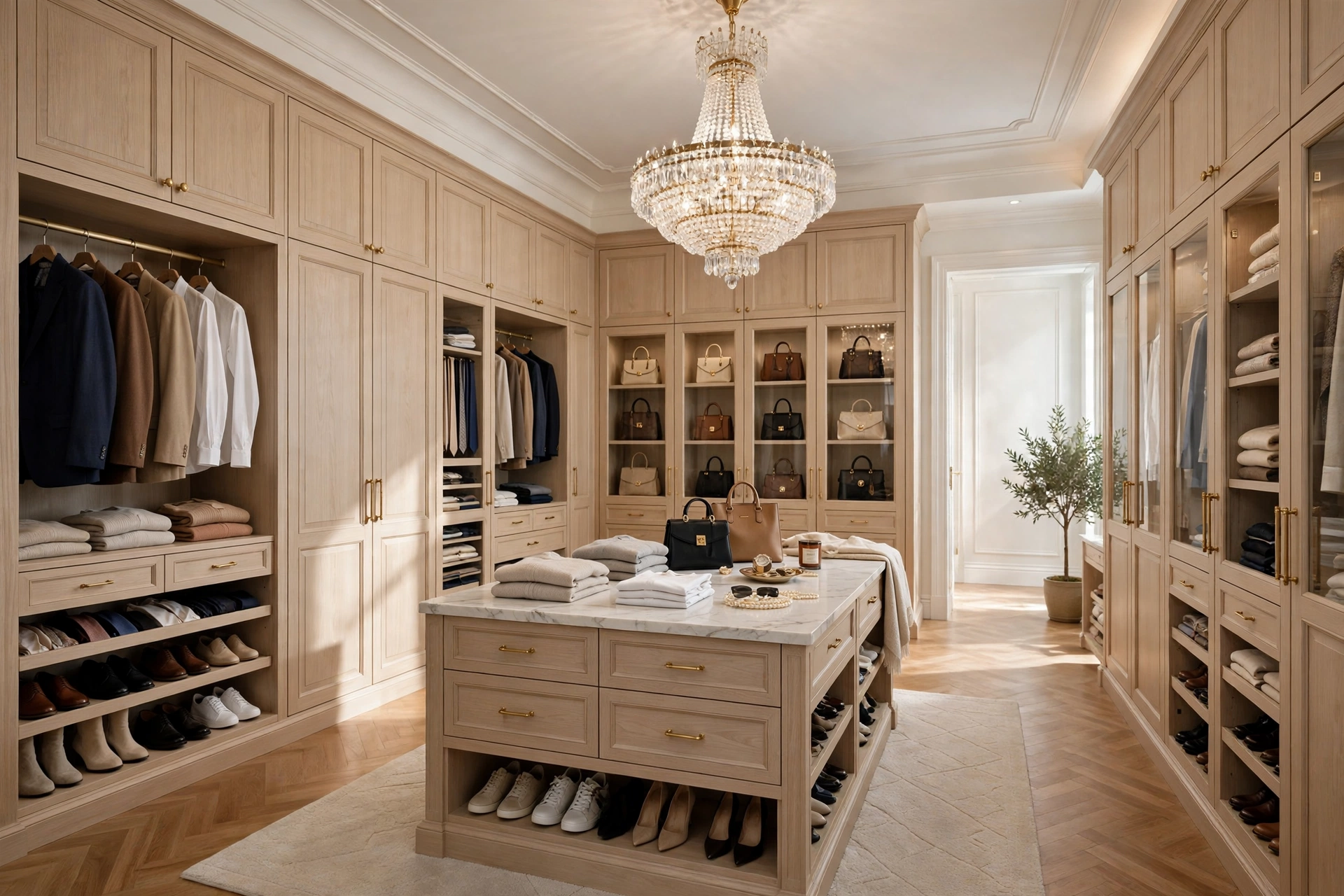
A great walk-in closet does something quietly radical: it makes getting dressed the calmest part of your day. No piles, no mystery boxes, no favourite shirt lost behind a stack of jumpers. The wardrobe rooms people save and share — the true walk-in closet goals — are rarely the biggest ones. They are the clearest ones, where every category has a home and the whole collection can be seen at a glance.
You do not need a spare bedroom to steal their best ideas. A modest walk-in, a wide alcove, or even a well-planned wall of wardrobes can borrow the same layout logic, lighting and finishing touches. This guide breaks down what to copy, in the order a designer would plan it. For more rooms in the same spirit, explore Millionaire Lifestyle.
Plan the Layout Before You Buy a Single Rail
Luxury closets feel generous because the circulation was planned first. Leave a comfortable clear walkway — enough to open drawers fully and turn around holding a hanger without brushing clothes on both sides. If your space cannot give you that on both walls, put storage on one wall and a mirror, hooks or low shoe shelves on the other, rather than squeezing rails everywhere.
Zones beat symmetry
Divide the room into zones by how you dress: everyday hanging, occasion and seasonal storage, shoes, folded knitwear, and accessories. Keep daily clothes at the front and at eye-to-hand height. Push formalwear, luggage and out-of-season boxes to the far end or up high. Designers call this the frequency rule, and it is the single habit that keeps a closet feeling effortless months after the big tidy.
The three hanging heights
Plan hanging in three lengths: full length for dresses and long coats, double hanging (two short rails stacked) for shirts, trousers and jackets, and a small section of single mid-length hanging if you own many blazers or long skirts. Most wardrobes are heavy on short items, so double hanging usually deserves the largest share. Measure your longest dress and your folded trouser length before fixing rail heights; guessing is how beautiful closets end up wasting a foot of air or crushing hems.
The Island: Useful, Not Just Photogenic
A central island is the image everyone pins, and in a room wide enough for one, it earns its place. It gives you a surface for folding and packing, drawers for underwear, socks, watches and jewellery, and a top that can hold a tray for perfume or a vase that makes the room feel finished.
If your walk-in is narrow, skip the island without regret and steal its functions instead: a shallow drawer bank under a window, a pull-out folding shelf, or a dresser just outside the closet door. Forcing an island into a tight room is the fastest way to make a luxury closet feel like an obstacle course. As an illustrative example, a smaller room might spend its island budget on better lighting and matching hangers instead — changes you will notice every single morning.
Doors, Drawers and Open Shelves: Pick Your Honesty Level
Open storage looks stunning and demands tidy owners. Closed storage forgives real life. Most copy-worthy closets mix the two on purpose.
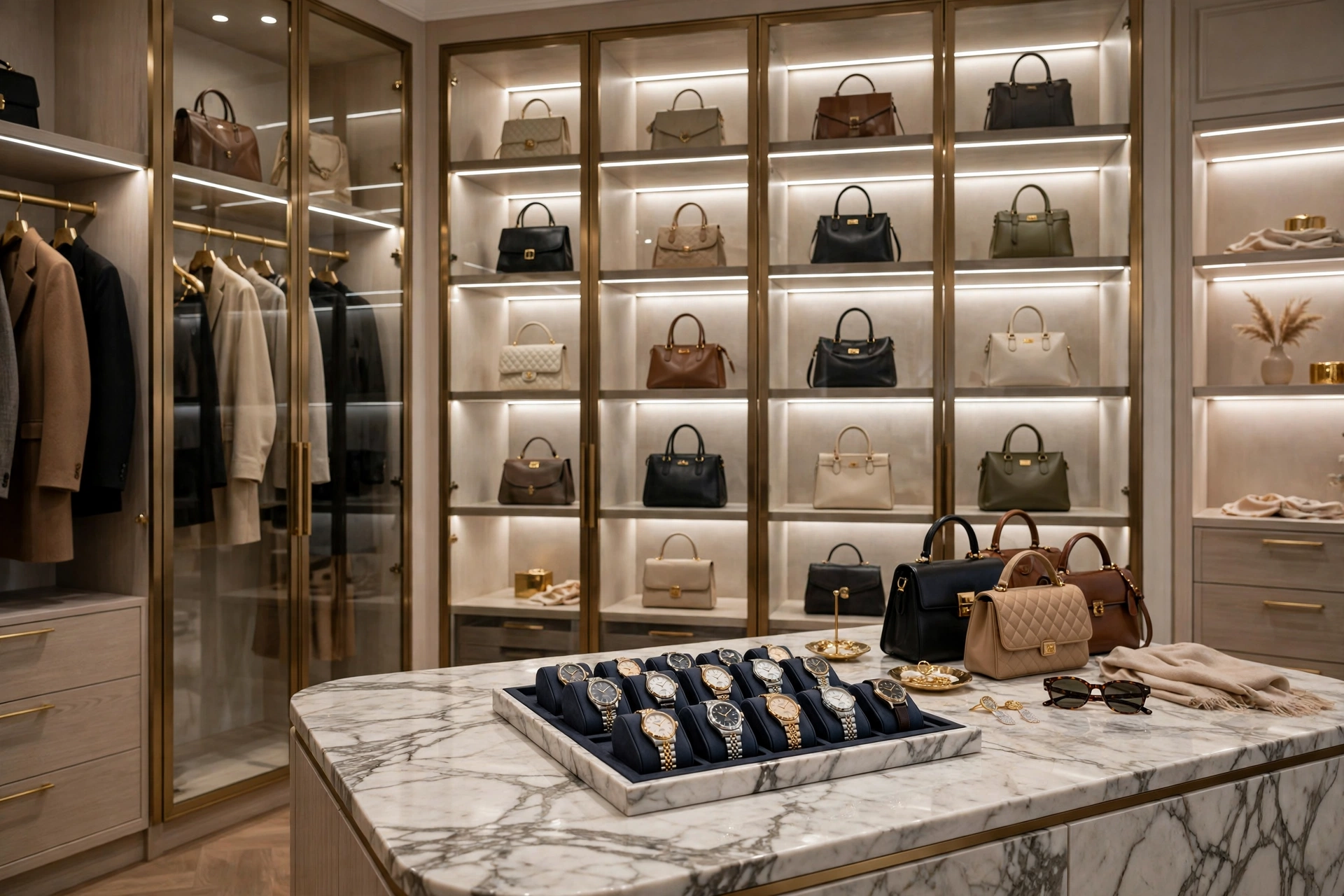
Open rails and shelves work for the clothes you wear constantly and can keep in order. Glass-fronted cabinets are the elegant middle ground for bags, shoes and occasion pieces: visible enough to enjoy and choose from, protected from dust. Solid doors or deep drawers should hide the visual noise — gym kits, cables, gift wrap, the sewing box — because a calm closet is mostly about what you do not see.
Drawers deserve dividers from day one. Without them, every drawer becomes a lucky dip within a month. Simple inserts for watches, belts, sunglasses and jewellery turn opening a drawer into a small boutique moment, and they make it obvious when you own three near-identical black belts and can stop buying a fourth.
Lighting: The Difference Between a Cupboard and a Boutique
Closets fail on lighting more than on storage. A single ceiling bulb leaves rails in shadow and makes navy look black. Layer it instead. Start with even ambient light from ceiling panels or spots. Add vertical LED strips inside hanging sections and under shelves so clothes are lit from the front, not just above. Finish with one decorative note — a small pendant or chandelier over an island, or a lit mirror at a vanity — that tells your brain this is a room, not a store cupboard.
Choose bulbs that render colour faithfully, and test a black, a navy and a deep green item under the light before you commit. If you dress early, a dimmer or a low-level warm setting lets you get ready without waking the whole house. Motion sensors for the main light are a small luxury that quickly feels essential.
Shoes, Bags and the Display Question
In the closets worth copying, shoes live on angled or flat shelves with enough height per pair, boots stand upright with shapers or rolled magazines inside, and everyday pairs sit lowest and closest to the door. Heels and occasion shoes can go higher; you will climb for them rarely and enjoy seeing them meanwhile.
Bags keep their shape stuffed lightly and stored upright, ideally in dust bags with a small photo or label on the shelf edge if you cannot see inside. That sounds fussy until you have searched five identical dust bags for one clutch. Watches and jewellery belong in lined drawers or a locked box within a drawer — displayed enough to wear often, secured enough for peace of mind.
The Vanity Corner and the Mirror
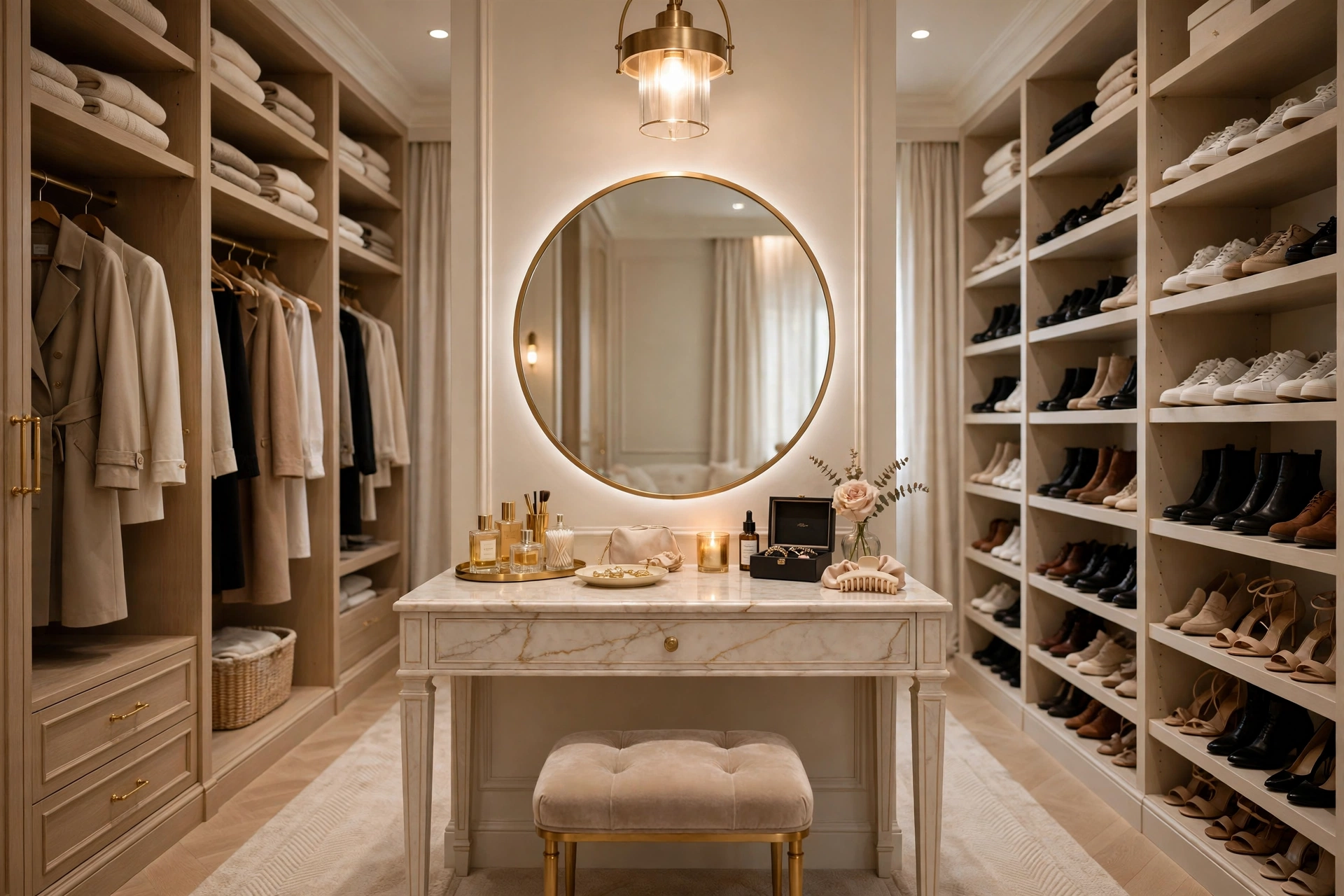
A small vanity — even just a shelf, a good mirror and a stool that tucks underneath — turns a closet into a dressing room. It is the place for skincare, fragrance and the final check, and it keeps those bottles off the bedroom surfaces. If space forbids a vanity, a full-length mirror on the inside of the door or on the end wall does most of the work. Check your outfit in the closet’s own good light before you leave it; you will catch the mismatched tones that bedroom lamplight hides.
Seating, even a single ottoman, changes how a closet is used. You sit to put on shoes, to pack, to decide. Rooms with somewhere to perch stay tidy longer, because nothing needs to be balanced on the floor while you think.
Hangers, Boxes and the Power of Matching
Nothing upgrades a closet faster or cheaper than uniform hangers. Slim, non-slip hangers in one colour free up rail space, stop shoulders from being misshapen by wire, and create the visual rhythm that makes a rail look curated. Matching storage boxes on the top shelf — labelled, lidded, one style — do the same for seasonal storage. Mismatched bags and shoeboxes are the visual equivalent of noise.
Keep one empty hanger at the front of each rail as a quiet signal: this closet has room to breathe, and anything new must earn its place by replacing something.
The Edit That Makes It All Work
Here is the honest part no photograph shows: every wardrobe room worth copying began with an edit. Systems cannot organise excess. Sort by category, keep what fits your actual life now, and store or release the rest before you measure for a single shelf. Then assign each kept category a home sized to it — no more. A rail that is eighty percent full looks luxurious and functions beautifully; a rail at a hundred and ten percent defeats any budget.
Maintain with tiny rituals: one item in, one item considered out; a ten-minute reset each week; a seasonal swap twice a year when boxes come down and go up. If you are planning fitted joinery, stage the spending — rails and lighting first, island and glass doors later — and model the stages with the free financial calculators so the project stays a pleasure rather than a pressure.
Small Walk-Ins, Same Goals
If your walk-in is really a step-in, you can still claim most of this: zones by frequency, double hanging where it counts, vertical lighting strips, matching hangers, lidded boxes up top, and a mirror that makes the space feel twice its size. Skip the island, keep the walkway sacred, and let one beautiful detail — a pendant light, a painted ceiling, a rug runner — carry the luxury. Goals were never about size. They are about opening a door each morning and finding a room that is ready for you.
