
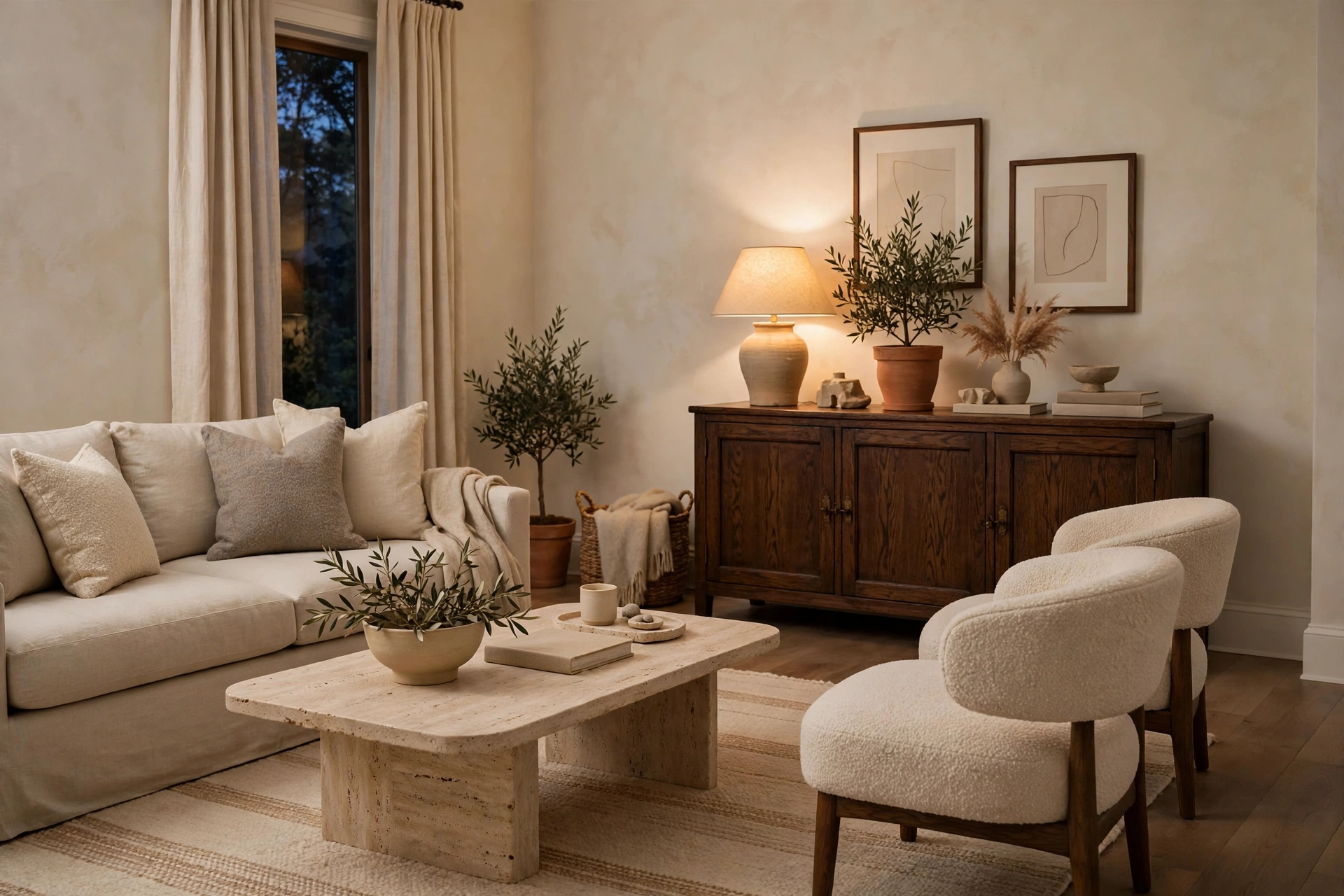
Quiet luxury is the living room that whispers. No logos, no gold taps shouting for attention, no trend-of-the-month colour dating the photographs by spring. Instead: beautiful materials, generous space between objects, colours borrowed from nature, and a feeling — hard to fake and easy to recognise — that everything in the room was chosen slowly and kept deliberately.
It is the most copied look in high-end interiors right now, and also the most misunderstood. Quiet luxury is not minimalism, not beige boredom and not an excuse to buy nothing. It is a discipline of colour, texture and editing. Here are its rules, made practical.
The Colors: A Palette That Lowers Your Heart Rate
Warm Neutrals as the Foundation
The base is warm, never stark: ivory, bone, oatmeal, warm white, soft greige and pale stone. These tones differ subtly from wall to sofa to curtain, creating depth through layering rather than contrast. Cool blue-greys and brilliant whites belong to a different, sharper style; quiet luxury always leans warm, because warm neutrals flatter skin, timber and evening light.
Nature’s Mid-Tones as the Second Layer
Over the neutrals come muted colours found outdoors: olive, sage, clay, taupe, camel, fog, mushroom and faded ink blue. They appear in cushions, a throw, an artwork, a pair of chairs — never everywhere at once. The test is simple: if the colour could plausibly be a stone, a leaf or a shadow, it belongs.
One Deep Anchor
Almost-black brown, espresso, charcoal or deep forest appears in small, grounding doses — a leather chair, a dark timber side table, the frame of an artwork. It stops the pale layers drifting into blandness. What you will not find is bright accent colour, metallic gold as a theme, or high-contrast pattern. Restraint with colour is the entry fee.
Paint deserves a note: choose matte or low-sheen finishes, consider colour-drenching walls, trim and ceiling in one tone for cocoon-like calm, and always test large swatches at different hours. Quiet colours shift dramatically with light, and their subtlety is the point.
The Textures: Where the Luxury Actually Lives
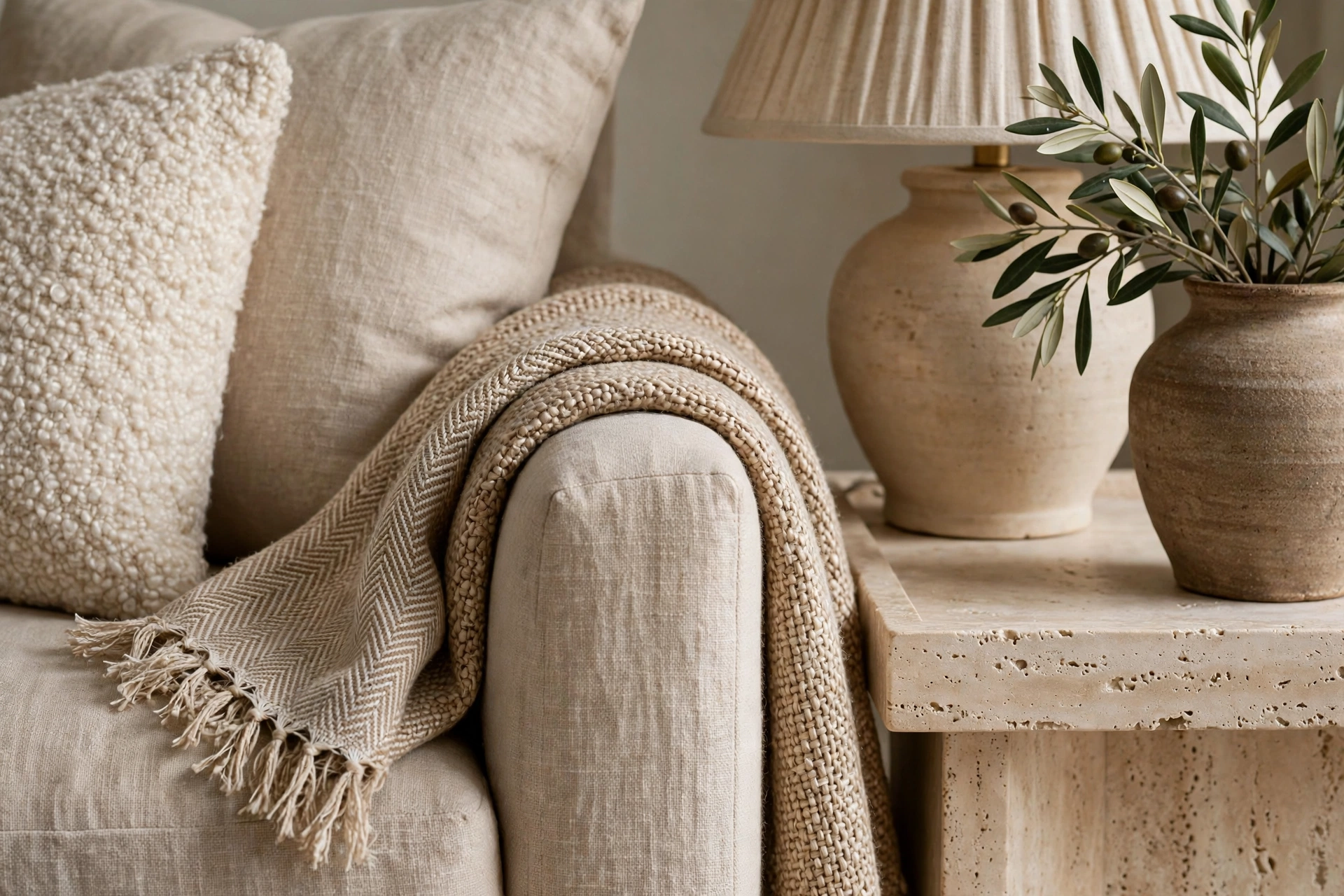
With colour subdued, texture carries the entire room. The rule designers use is contrast of touch in every sightline: something smooth, something rough, something soft, something woven — within the same calm palette.
The Core Texture Library
Linen in a visible, slubby weave for sofas and curtains. Wool — as boucle upholstery, a knitted throw or a deep-pile rug. Natural timber with the grain left honest, ideally in two finishes, one pale and one dark. Stone with a honed, matte surface: travertine, limestone or marble without the mirror polish. Plaster or limewash walls that catch light unevenly and softly. Leather that will patina. Ceramic with a handmade irregularity. Cane, rattan and woven grasses in small, architectural doses.
Aim for at least five distinct textures in the seating area. Count them honestly in most rooms and you will find two — fabric and wood — which is why so many neutral rooms feel flat rather than serene.
Pattern, Kept on a Leash
Quiet luxury is not anti-pattern; it is anti-noise. A subtle stripe in the same tones, a faint herringbone in a rug, the natural veining of stone — pattern at whisper volume. If you can see it from the doorway, it is probably too loud for this style.
The Rules: How Quiet Luxury Rooms Are Run
Rule One: Fewer, Larger, Better
One generous sofa beats a matching three-piece suite. One large artwork beats a cluster of small frames. One substantial stone coffee table beats three nesting tables. Scale creates calm because the eye has fewer decisions to make, and quality becomes visible when it is not competing for attention.
Rule Two: Space Is a Material
Leave breathing room — between furniture and walls, between objects on a shelf, between the rug edge and the skirting. Empty space is not wasted space in this style; it is the background that makes good pieces legible. If a room feels almost right but slightly tense, remove one thing before adding anything.
Rule Three: Nothing Shouts Its Price
No visible branding, no novelty shapes designed for photographs, no finishes chosen because they look expensive rather than because they are beautiful and durable. Quiet luxury trusts material and proportion to speak. A solid oak table with perfect proportions says more than a famous logo ever will.
Rule Four: Light Softly, in Layers
Warm light only, from several low sources: linen-shaded lamps, wall lights washing plaster, candlelight, a dimmed central fixture in plaster, alabaster or woven material rather than crystal sparkle. Curtains are full-length linen, often unlined sheers layered with heavier drapes, hung high and wide so daylight enters diffused.
Planning a room refresh in stages — paint, textiles, then furniture — is easier when the budget is staged too. The tools on our financial calculators hub help map that kind of phased plan before the first sample pot opens.
Rule Five: Buy for Touch and Time
Every purchase faces two questions: how does it feel, and how will it age? Natural materials pass both — linen softens, leather deepens, timber and stone gather character. Synthetics that mimic them often fail the second test, looking tired exactly when real materials look best. Quiet luxury is a long game.
A Quiet Luxury Living Room, Assembled
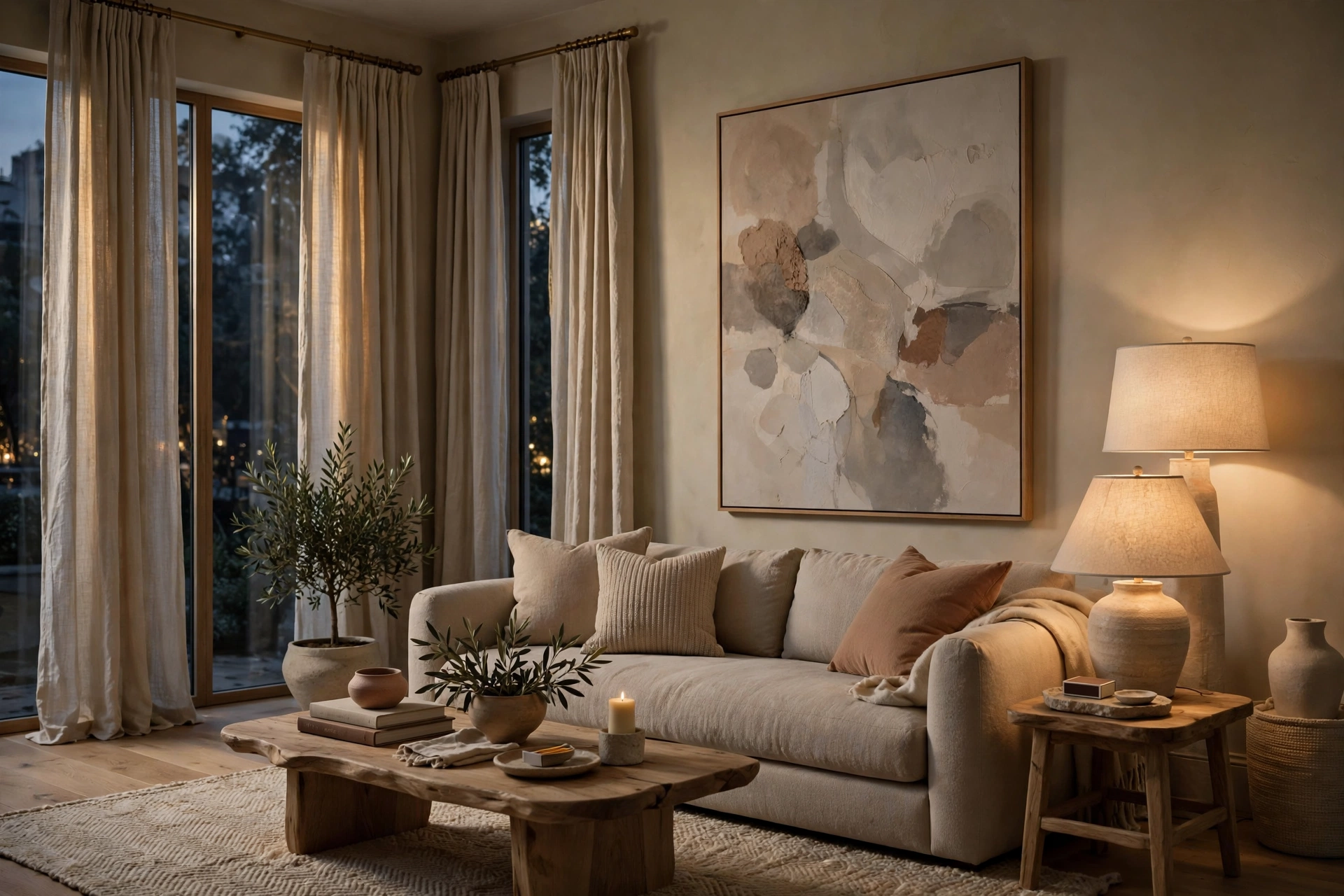
Picture the finished recipe. Limewashed warm-white walls. A deep linen sofa in oatmeal, two boucle chairs in bone, a travertine coffee table, a dark oak sideboard. A wool rug in undyed tones under all of it. One large, soft abstract artwork in clay and stone hues. A ceramic lamp, a stack of cloth-bound books, a single olive branch arrangement in a heavy vase. Linen curtains moving slightly. Nothing matches; everything belongs.
Seating comfort is non-negotiable — this style fails completely in a room nobody wants to sit in. Cushions are feather-wrapped, throws are within reach, and side tables sit exactly where a cup needs to land. Calm that is not comfortable is just a photograph.
Quiet Luxury on a Realistic Budget
This style is often described as expensive, and quality materials do cost more per piece. But its arithmetic is friendlier than it first appears, because the look depends on owning less. One well-made sofa in a durable natural fabric, kept for a decade, replaces three fashionable ones. Limewash paint transforms walls for the price of a weekend. Linen curtains, a wool rug and two good lamps will carry a room further than a cart of small accessories ever will.
Spend first where hands and eyes land daily: sofa fabric, rug, main artwork, lighting. Save by keeping window treatments simple, choosing vintage timber furniture — solid wood ages exactly as this style wants — and letting empty space do work that objects do in other styles. Second-hand stone, leather and oak often suit quiet luxury better than new imitations, because their patina is real.
Phasing matters too. Repaint and edit first, live with the calmer room, then replace one major piece at a time as budget allows. Each upgrade is more visible in an uncluttered room, which makes the slow route surprisingly satisfying rather than frustrating.
What to Remove First
If you are converting an existing room, subtraction does most of the work. Remove bright-white and cool-grey elements that fight the warm palette. Remove small decorative objects in groups — keep the best one, store the rest. Remove shiny metallic accents beyond a single muted brass or bronze note. Remove word art, novelty cushions and any furniture kept from obligation rather than love. Then live with the edited room for a week before buying anything; quiet luxury rewards patience and punishes impulse carts.
For more calm, material-led interiors — from island houses to penthouses — browse the Millionaire Lifestyle archive.
The Quiet Test
Stand in the doorway in the evening, lamps on, and ask three questions. Does the room feel calm before it feels impressive? Does everything invite touch? Could this room belong to any year in the last twenty — or the next twenty? If the answers are yes, you have it. Quiet luxury is not a shopping list. It is the decision, repeated daily, to let quality and rest do the talking.
